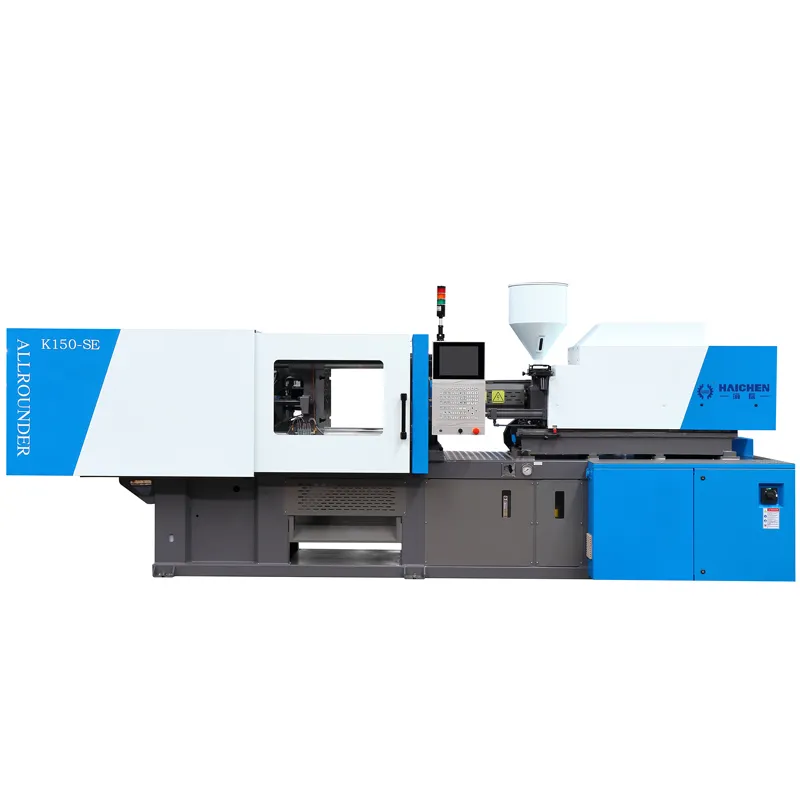
Types of plastic buckets are water buckets, paint buckets, food buckets,thin-wall commodity buckets, trash cans, and different manufacturing processes, including Injection molding, rotational molding, blow molding, extrusion molding, and thermoforming.
A plastic bucket is a common container made of plastic. It is widely used in daily life and work; besides, it has many advantages over other containers.
It is light, durable, and easy to carry in daily life. Additionally, it also has good sealing and is not easy to break.
It is light, durable, and easy to carry in daily life. Additionally, it also has good sealing and is not easy to break.
All in all, these features make it very practical. Many manufacturers design and produce plastic buckets.
Different manufacturers have different product styles; for example, some focus on daily use, while others focus on industrial use.
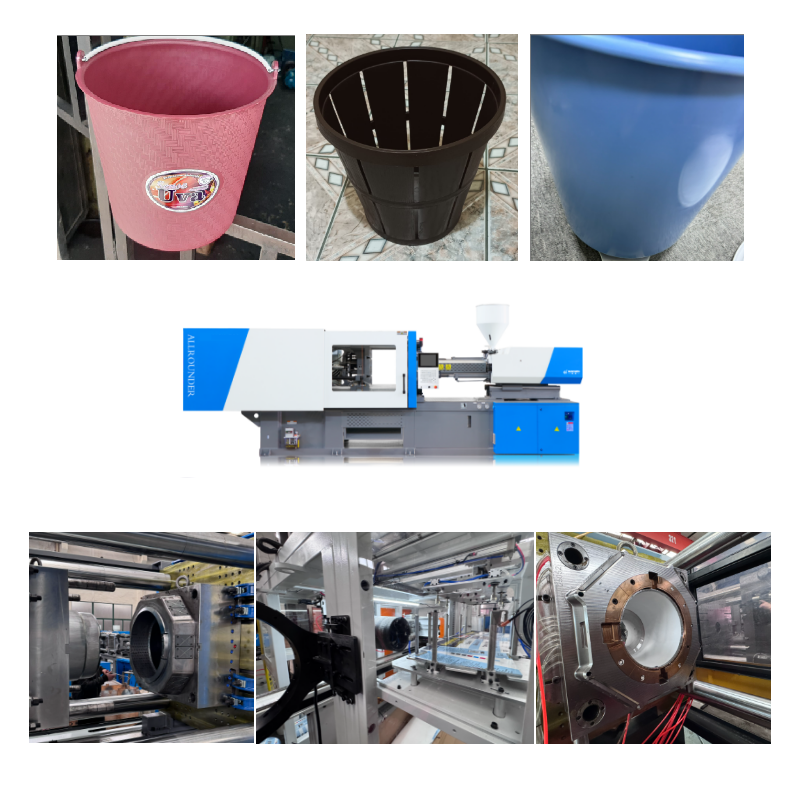
Basic Types of Plastic Buckets
- Water Buckets
- Paint Buckets
- Food Buckets
- Thin-Wall Commodity Buckets
- Plastic Trash Cans
Water Buckets
To begin with, water buckets are mainly for holding daily water. Besides, they are not only practical but also usually strong and sturdy. If they have lids, they can seal well.
Besides, they are very common in homes, gardens, and construction sites.
These buckets are light and durable. Consequently, they are great for daily water storage and carrying.
Their size is reasonable to hold enough water.
These buckets are light and durable. Consequently, they are great for daily water storage and carrying.
Their size is reasonable to hold enough water.
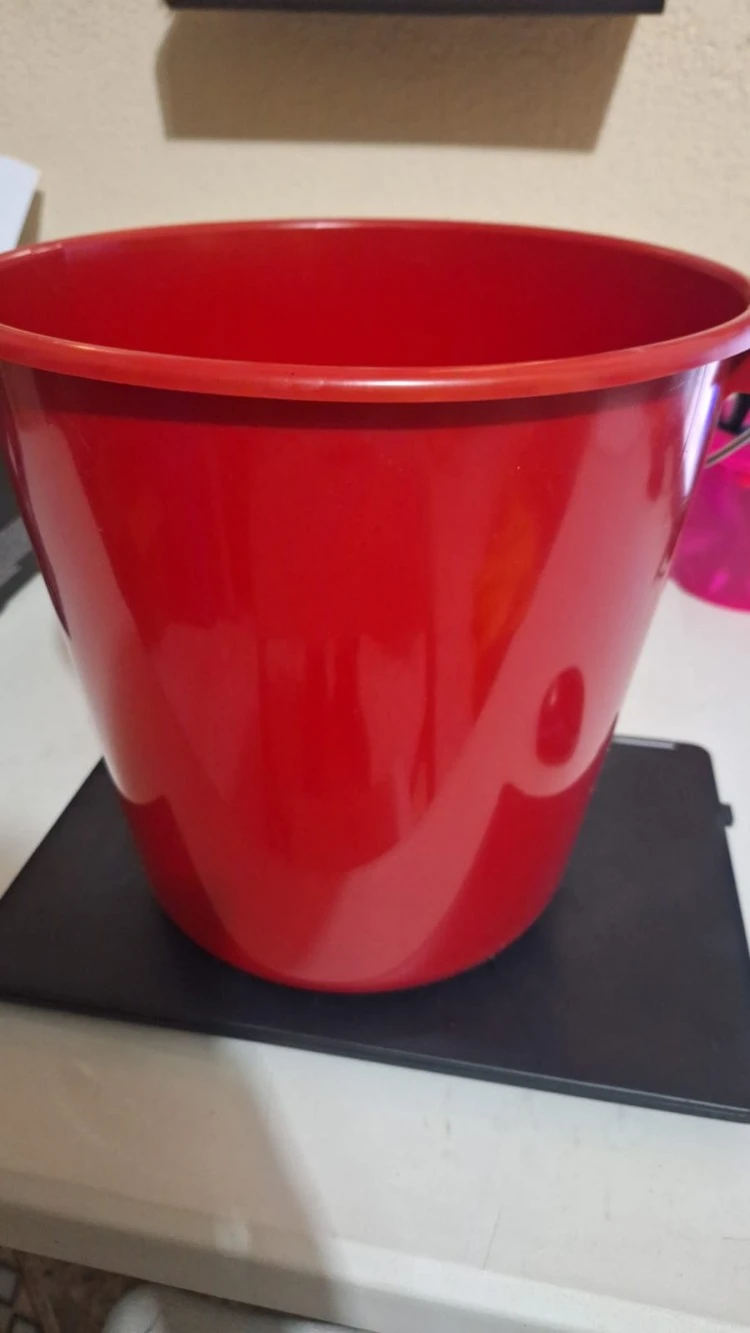
Paint Buckets
To begin with, paint buckets are for storing and carrying paint or ink. Furthermore, they can also hold other thick liquids.
Generally, they have thick walls and tight lids. This, in turn, can prevent liquid from leaking out.
They are made of corrosion-resistant materials. As a result, they won’t react with paint. Moreover, these buckets are easy to clean and reuse.
They are made of corrosion-resistant materials. As a result, they won’t react with paint. Moreover, these buckets are easy to clean and reuse.
Accordingly, they are cost-effective for home and industrial use. You can use them many times without trouble.
Food Buckets
Firstly, food buckets hold food, snacks, seasonings, or grains. Besides, they adopt non-toxic materials like PP. Above all, this ensures food safety for people to use.
They often have airtight lids to keep food fresh. Moreover, the lids also prevent insects from getting in. Besides, they come in many small sizes. Therefore, they are suitable for home use.
They often have airtight lids to keep food fresh. Moreover, the lids also prevent insects from getting in. Besides, they come in many small sizes. Therefore, they are suitable for home use.
Thin-Wall Commodity Buckets
Generally, thin-wall commodity buckets are light and small. Additionally, they mainly hold small goods, snacks, or small parts.
Furthermore, they are cheap and easy to carry around.
Overall, their design is simple and beautiful. As a result, they can attract customers’ attention.
Plastic Trash Cans
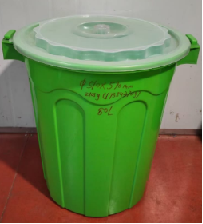
Generally, plastic trash cans collect garbage in daily life and work. Besides, they are usually light and easy to clean.
Consequently, they are suitable for homes, offices, and public places.
They often have lids to stop odor from spreading. Additionally, they are made of durable plastic.
They often have lids to stop odor from spreading. Additionally, they are made of durable plastic.
They are not easy to break. Hence, they can be used for a long time in different places.
Different production processes of plastic buckets
- Injection Molding
- Rotational Molding
- Blow Molding
- Extrusion Molding
- Thermoforming
Injection Molding
Injection molding is the most widely used process.
It has high production efficiency. Furthermore, it makes products with precise sizes. What’s more, the quality is also stable.
It has high production efficiency. Furthermore, it makes products with precise sizes. What’s more, the quality is also stable.
Consequently, it is great for large-scale mass production.
The process is simple to understand. Firstly, dry plastic raw materials like PP or HDPE.
The process is simple to understand. Firstly, dry plastic raw materials like PP or HDPE.
Accordingly, this removes moisture and avoids bubbles. After that, put dried plastic particles into an injection molding machine.
Then heat and melt the particles into a viscous liquid. Subsequently, inject the liquid into a closed bucket mold.
Meanwhile, use high pressure to fill the mold. Afterwards, cool the mold down slowly.
Open the mold and take out the plastic bucket. Finally, trim excess plastic and polish the product.
Open the mold and take out the plastic bucket. Finally, trim excess plastic and polish the product.
Rotational Molding
Rotational molding is also called rotomolding. It is a special production process. Primarily, it is mainly applied to large water storage buckets and chemical buckets.
Additionally, it is also used for manufacturing agricultural water tanks.
First, put plastic powder (usually PE) into a hollow mold. Then, heat the mold and rotate it along two axes.
The mold’s linear speed is usually 6-35rpm. Meanwhile, gravity and heat make the powder melt. Then the melted powder coats the mold’s inner wall evenly.
Cool the mold with air for stable quality. Then, open the mold and take out the finished product. There is no high-pressure step in this process.
>Hence, the product has no internal stress. Furthermore, it has excellent toughness and can bear impact. It can also stand pressure well.
Blow Molding
Blow molding, especially hollow blow molding. It is another core process for plastic buckets. It is mainly for large-capacity hollow buckets. Furthermore, the process has several simple steps.
First, melt plastic raw materials. Afterwards, extrude the melted plastic into a tubular parison.
Then, clamp the parison into a split mold. Insert a blow rod and inject high-pressure air. Air pressure makes the parison expand.
Consequently, it fits closely with the mold’s inner wall. Besides, the cooling time is over 60% of the whole cycle.
Then, open the mold and take out the product. Trim the product to get the finished bucket.
Extrusion Molding
Basically, extrusion molding makes simple-structured buckets. It also makes bucket bodies.
First of all, melt plastic raw materials with an extruder. Then, extrude them into a continuous bucket blank through a die.
First of all, melt plastic raw materials with an extruder. Then, extrude them into a continuous bucket blank through a die.
Finally, cut the blank to the needed length. Then, process the bucket bottom and mouth.
Thermoforming
Basically, thermoforming is for thin-wall buckets and small lids. Besides, it heats plastic sheets to a softened state.
Then, press the sheet into the mold. First, use air pressure or mechanical pressure.
Afterwards, cool the sheet to form the needed shape. Moreover, it boasts a fast production speed. In addition, the mold cost is low.
However, at the same time, the performance of this product is relatively low.
>Thus, it is mostly for disposable plastic buckets.
>Thus, it is mostly for disposable plastic buckets.
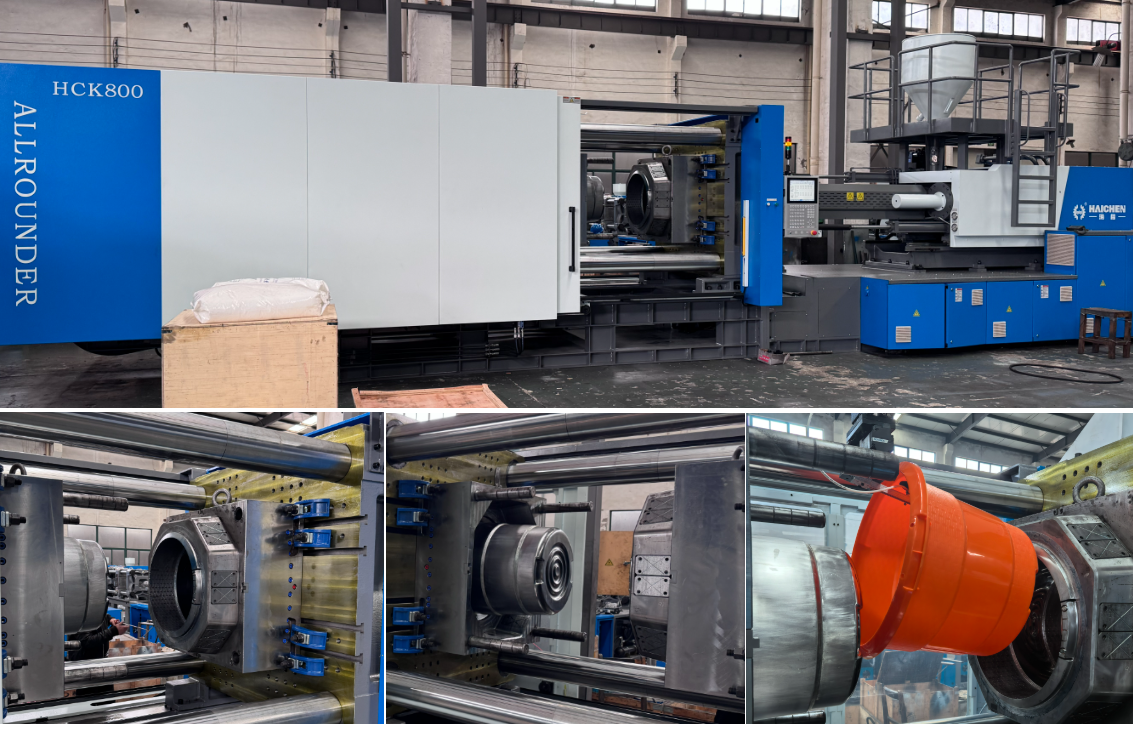
Haichen Injection Molding Plastic Buckets
Haichen is a professional injection molding machine manufacturer, and it has been in the industry for many years.
Furthermore, it owns advanced technology as well as a professional technical team. In addition, it has rich experience not only in designing plastic buckets but also in mass production.
Besides, it is capable of customizing products strictly according to customer demands; meanwhile, it carries out rigorous quality control throughout production.
As a result, Haichen’s plastic buckets boast reliable quality; consequently, their prices stay highly reasonable.
Evidently, these products are well-received by global clients; hence, numerous buyers prefer to choose Haichen goods.
What’s more, the brand supplies diversified plastic buckets to satisfy diverse demands.
Specifically, it provides proper products for household use; equally important, it also launches items fit for outdoor and industrial scenarios.
| Haichen injection molding machine model | Types of plastic buckets | The weight of the bucket | The capacity of the bucket | bucket size | Mould Cavity | Mould Material | |
| HCK310 |
|
IML plastic buckets | 30g | 500GM | Top outer diameter:93.6MM • Height:114MM • Bottom outer diameter:74.10MM • Top inner diameter:85.20MM • Weight:19.75 GM • Thickness:0.45 MM |
1 Cavity | P20/H13 |
| HCK530 |
|
Paint bucket | 300g | 4L | Bottom Diameter: 260mm Top diameter:290 Height: 380mm |
1 Cavity | P20/H13 |
| HCK800 |
 |
Water Bucket | 1500g | 85L | Diameter: 520mm Height: 400mm |
1 Cavity | P20/H13 |
| HCK1300 |
|
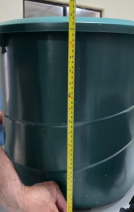
Trash can | 1735g | 80L | Diameter: 510mm Height: 590mm |
1 Cavity | P20/H13 |
Haichen Injection Molding Machine Parameters
| UNIT | HCK310 | HCK530 | HCK800 | HCK1300 | HCK1500 | HCK1850 | |||||||||||||||||
international size rating |
1900 | 4000 | 6500 | 14000 | 18200 | 22000 | |||||||||||||||||
| A | B | C | A | B | C | A | B | C | D | A | B | C | D | A | B | C | D | A | B | C | D | ||
| mm | 60 | 65 | 70 | 80 | 85 | 90 | 95 | 100 | 110 | 120 | 120 | 130 | 140 | 150 | 130 | 140 | 150 | 160 | 140 | 150 | 160 | 170 | |
| Screw L:D ratio | 21.7 | 20.0 | 18.6 | 23.4 | 22.0 | 20.8 | 23.2 | 22.0 | 20.0 | 18.3 | 23.8 | 22.0 | 20.4 | 19.1 | 23.7 | 22.0 | 20.5 | 19.3 | 23.6 | 22.0 | 20.6 | 19.4 | |
| Shot volume | cm3 | 919 | 1078 | 1251 | 2187 | 2468 | 2767 | 3544 | 3927 | 4752 | 5655 | 7351 | 8628 | 10006 | 11486 | 9291 | 10776 | 12370 | 14074 | 11545 | 13254 | 15080 | 17024 |
| Shot weight(PS) | g | 836 | 981 | 1138 | 1990 | 2246 | 2518 | 3225 | 3574 | 4324 | 5146 | 6689 | 7851 | 9105 | 10452 | 8455 | 9806 | 11257 | 12807 | 10506 | 12061 | 13723 | 15492 |
| oz | 29.5 | 34.6 | 40.1 | 70.2 | 79.2 | 88.8 | 113.8 | 126.1 | 152.5 | 181.5 | 235.9 | 276.9 | 321.2 | 368.7 | 298.2 | 345.9 | 397.1 | 451.7 | 370.6 | 425.4 | 484.1 | 546.5 | |
| Injection pressure | Bar | 2078 | 1771 | 1527 | 1912 | 1700 | 1510 | 1846 | 1666 | 1377 | 1157 | 1925 | 1640 | 1414 | 1232 | 1959 | 1689 | 1471 | 1293 | 1913 | 1666 | 1464 | 1297 |
| Injection rate | cm3/s | 281 | 330 | 383 | 509 | 574 | 643 | 712 | 789 | 954 | 1136 | 1136 | 1334 | 1547 | 1775 | 1341 | 1555 | 1785 | 2031 | 1525 | 1751 | 1992 | 2249 |
| Plasticizing capacity | g/s | 42 | 51 | 60 | 59 | 70 | 89 | 76 | 88 | 110 | 132 | 135 | 159 | 198 | 233 | 156 | 195 | 229 | 246 | 191 | 225 | 241 | 258 |
| Max. screw speed | r/min | 200 | 140 | 120 | 115 | 113 | 111 | ||||||||||||||||
Clamping force |
KN | 3100 | 5300 | 8000 | 13000 | 15000 | 18500 | ||||||||||||||||
| Space between tie bars | mm | 670×620 | 870×820 | 1050×1000 | 1250×1250 | 1450×1350 | 1650×1500 | ||||||||||||||||
| mm | 950×880 | 1270×1220 | 1470×1390 | 1820×1820 | 2090×2080 | 2410×2280 | |||||||||||||||||
| Opening stroke | mm | 610 | 850 | 1030 | 1300 | 1500 | 1650 | ||||||||||||||||
| Min. mold height | mm | 270 | 320 | 400 | 550 | 700 | 800 | ||||||||||||||||
| Max. mold height | mm | 670 | 870 | 1050 | 1300 | 1450 | 1700 | ||||||||||||||||
| Distance between platens(daylight) | mm | 1280 | 1720 | 2080 | 2600 | 2950 | 3350 | ||||||||||||||||
| Ejector stroke | mm | 170 | 220 | 270 | 320 | 350 | 400 | ||||||||||||||||
| Ejector force | kN | 90 | 120 | 190 | 220 | 320 | 430 | ||||||||||||||||
| Number of ejectors | 13 | 13 | 17 | 25 | 25 | 25 | |||||||||||||||||
Systolic pressure |
Bar | 175 | 175 | 175 | 175 | 175 | 175 | ||||||||||||||||
| Pump motor | kW | 38 | 60 | 42+42 | 42+42+42 | 42+54+54 | 42+54+54+54 | ||||||||||||||||
| Heating capacity | kW | 20.0 | 40.0 | 50.0 | 71.0 | 91.0 | 100.0 | ||||||||||||||||
| Oil tank capacity | L | 400 | 650 | 800 | 1100 | 1300 | 1500 | ||||||||||||||||
| Machine dimension(L×W×H) | m×m×m | 6.5×1.6×2.3 | 9.1×2.2×3.0 | 11×2.35×3.5 | 12.7×2.7×4.2 | 13.8×3.1×4.5 | 15.6×4.6×5.2 | ||||||||||||||||
| Machine weight | t | 9.7 | 21 | 38 | 65 | 87 | 130 | ||||||||||||||||
| Hopper capacity | kg | 50 | 50 | 100 | 100 | 400 | 400 | ||||||||||||||||