
Plastic clips are small parts, but their production can require careful mold and machine planning.
A clip may have thin sections, a gripping area, ribs, holes, or other small features. At the same time, many clip products require high cavity molds because each part is relatively small.
For this reason, plastic clip injection molding should start with the product and mold rather than machine tonnage alone.
The right machine depends on the clip design, material, mold cavity number, production target, and automation level.
In some applications, a horizontal injection molding machine works well for high-volume production.
In other applications, a vertical machine can make insert loading easier.
So, how should you choose?
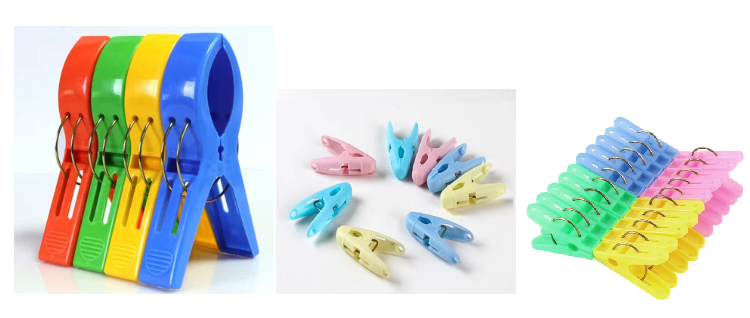
What Plastic Clips Can Be Made by Injection Molding?
Injection molding can produce many types of plastic clips.
Common examples include:
- Plastic clothespins
- Clothes hanger clips
- Cable clips
- Fixing clips
- Plastic clamps
- Small industrial clips
- Snap-fit clips
These products do not all have the same molding requirements.
For example, a simple all-plastic clip may focus on production speed and automatic part removal.
A clip with a special insert may require easier mold access for insert placement.
The product structure should therefore guide the machine selection.
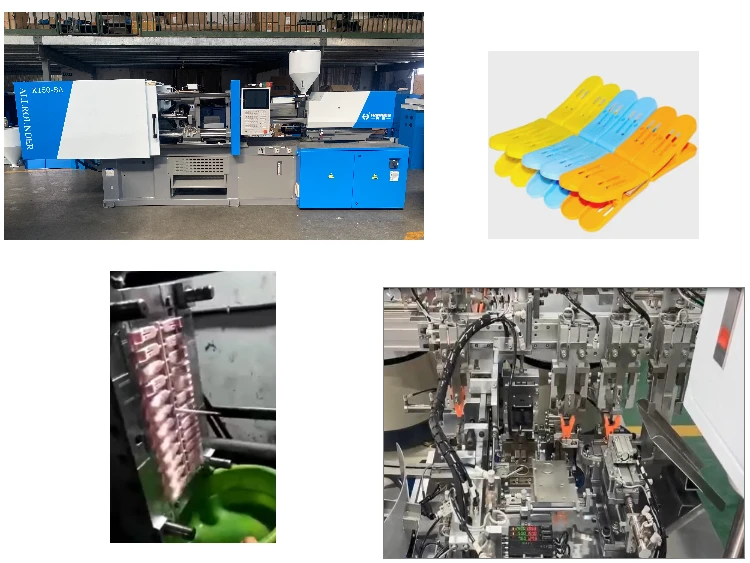
What Makes Plastic Clip Injection Molding Different?
The small size of a clip can make high-volume production possible. However, small size does not mean the molding process is automatically simple.
Several features can affect production.
Thin Sections
Some clips have thin walls or narrow connecting areas. The plastic must fill these sections before it cools too much.
The mold gate, runner, injection speed, and material all affect filling.
Gripping Areas
A clothespin or clamp needs the correct shape around the gripping area.
If this area changes during molding, the finished product may not work as expected.
Therefore, dimensional stability matters as much as appearance.
Ribs and Small Features
Ribs can improve product strength, but they also change the way the plastic flows and cools.
The mold should provide enough filling and cooling control around these areas.
High Cavity Production
Plastic clips are often small. This makes multi-cavity molds attractive for high-volume production.
However, more cavities also increase mold complexity.
The mold must maintain balanced filling and cooling across the cavities. Otherwise, different cavities may produce parts with different weights or dimensions.
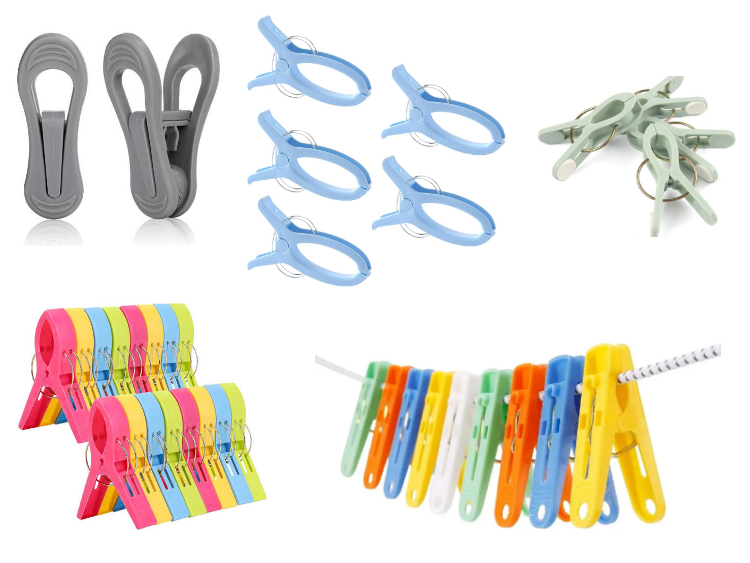
How Is a Plastic Clip Mold Designed?
The mold has a direct effect on production efficiency.
Before choosing the injection molding machine, the manufacturer should consider:
- Product dimensions
- Product weight
- Cavity number
- Cavity layout
- Gate position
- Runner design
- Cooling channels
- Venting
- Ejection
- Mold dimensions
Cavity Number
Cavity number is one of the first production decisions.
A 4-cavity mold produces four clips per cycle. A 16-cavity mold produces sixteen. A 32-cavity mold produces thirty-two.
More cavities can increase output without increasing the number of injection molding machines.
However, the mold also becomes more complex. The machine must have enough injection capacity and clamping force for the complete mold.
Gate and Runner Design
The gate controls how the plastic enters each cavity.
For a multi-cavity clip mold, balanced filling becomes especially important.
A good runner system can help the cavities fill more evenly. The gate location also affects weld lines, packing, appearance, and product strength.
Cooling
Cooling affects both cycle time and product stability.
If different areas of the clip cool at different speeds, the product may warp or change dimensions.
Therefore, the cooling system should follow the actual clip geometry instead of using a simple standard layout.
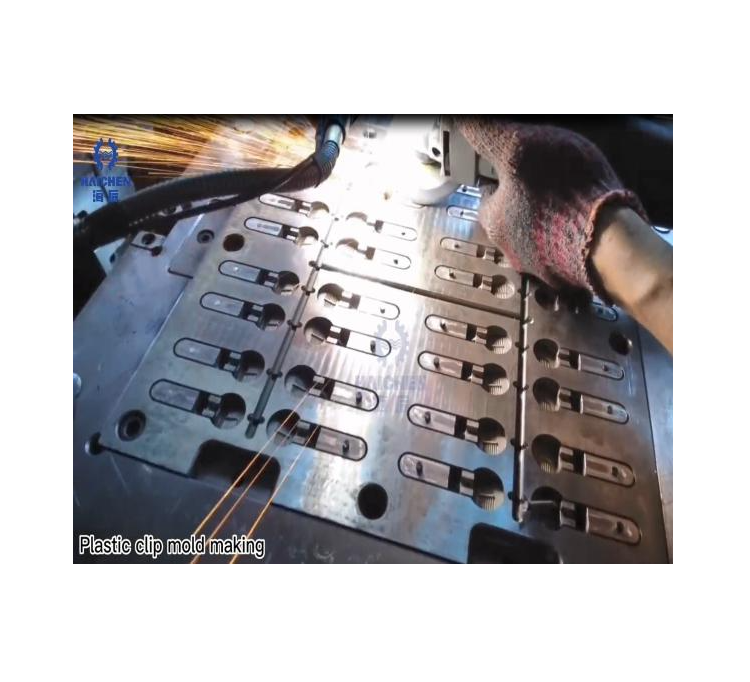
What Machine Is Used for Plastic Clip Injection Molding?
The injection molding machine should match the complete mold and production process.
The main points include:
Clamping Force
The machine needs enough clamping force to keep the mold closed during injection.
The required force depends on the total projected area and molding conditions.
A small clip does not automatically mean a small machine.
For example, a single clip may weigh only a few grams, but a 32-cavity or higher-cavity mold can have a much larger total projected area.
So, machine tonnage should come from the actual mold rather than the product name.
Injection Capacity
The injection unit needs enough capacity for:
- All molded parts
- Runner material, when applicable
- The selected processing conditions
The machine should also have a reasonable operating margin.
Running an injection unit continuously at its maximum capacity is not a good basis for stable production planning.
Mold Fit
The mold must physically fit the machine.
Check:
- Tie-bar spacing
- Platen dimensions
- Mold height
- Mold opening
- Ejector stroke
- Mold weight
A machine may have enough clamping force but still fail the mold-fit requirements.
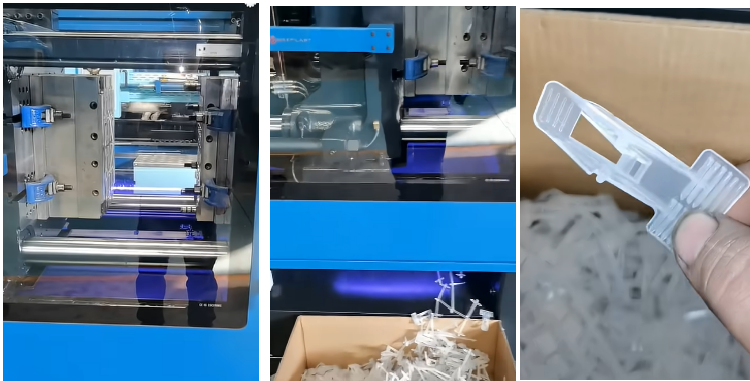
Vertical or Horizontal Machine: Which One Should You Choose?
There is no universal answer.
The machine orientation should follow the actual clip structure and production method.
When Is a Vertical Machine Useful?
A vertical injection molding machine can be useful when the production process requires convenient access to the mold.
For example, some applications involve placing an existing component into the mold before injection.
In these cases, mold accessibility can make manual or semi-automatic loading easier.
However, insert molding is only one application. A vertical machine should not be selected simply because the product is called a “clip.”
The actual mold and production process still need to support the choice.
When Is a Horizontal Machine Useful?
A horizontal injection molding machine can be practical for all-plastic clips and high-volume production.
After the mold opens, the finished parts can often move directly to:
- A robot
- A take-out system
- A conveyor
- A collection system
This makes it easier to build an automatic production process.
For a simple PP or PS clip made with a high-cavity mold, a horizontal machine can be a practical choice when the main goal is continuous production.
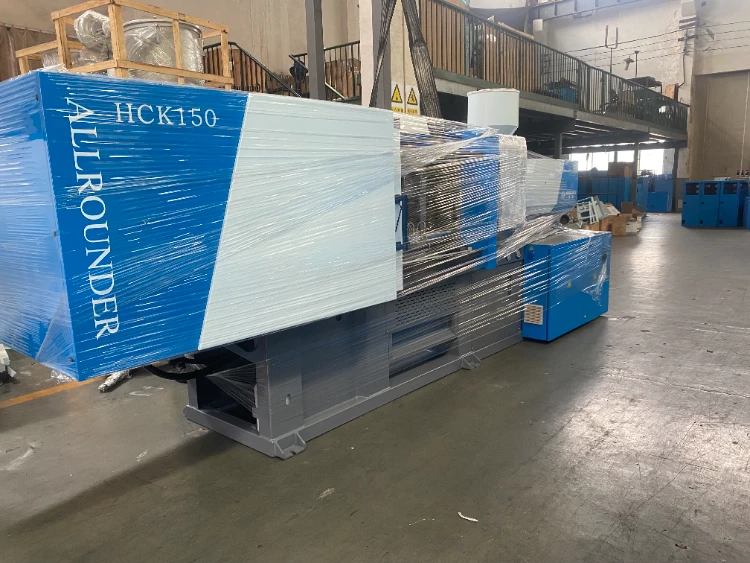
Vertical vs. Horizontal Injection Molding Machines
The two machine types have different strengths.
| Production requirement | Vertical machine | Horizontal machine |
|---|---|---|
| All-plastic clip | Suitable | Suitable |
| High-volume production | Application dependent | Often practical |
| Automatic part removal | Application dependent | Convenient |
| Conveyor integration | Possible | Convenient |
| Manual insert loading | Convenient in suitable applications | Application dependent |
| Insert molding | Often useful | Possible |
| High-cavity production | Depends on machine and mold | Often practical |
| Automation | Possible | Often convenient |
This comparison does not mean one machine type always wins.
The correct choice depends on the product and mold.
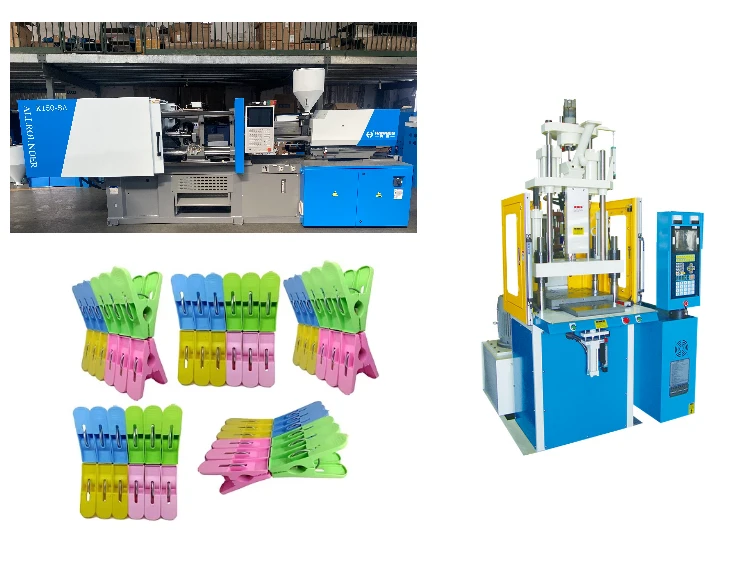
How Does Automation Improve Plastic Clip Production?
Automation becomes more important as production volume increases.
A basic automated process can look like this:
Material Feeding → Injection Molding → Part Removal → Conveying → Inspection → Packing
Depending on the product, manufacturers can add:
- Automatic take-out
- Conveyor
- Counting system
- Vision inspection
- Automatic packing
- Automatic assembly
For simple plastic clips, automatic part removal can reduce manual handling.
For clips that need assembly with another component, the production line can also include a separate assembly step.
The automation level should match the actual production target. A small factory does not always need a fully automatic line from the beginning.
Real Plastic Clip Injection Molding Case
Haichen has published a plastic clothespin production reference using an HCK110 injection molding machine.
The published case includes:
- Product size: 9 × 2.8 × 1 cm
- Product weight: 5.5 g
- Material: PP/PS
- Mold: 32 cavities
- Cycle time: 15 seconds
The same page also shows 12-cavity and 32-cavity clothespin mold examples, machine testing, and a fully automatic clothespin assembly machine.
This case shows an important point:
The machine cannot be selected from product weight alone.
A 5.5 g clip sounds very small. However, a 32-cavity mold produces many parts in one cycle, so the complete mold and production target must be considered.
Haichen’s published material also describes a clothespin production process that starts with product drawings, followed by mold design, injection molding, cooling, and demolding.
How Do You Calculate Plastic Clip Production Capacity?
The basic theoretical output formula is:
Output per hour = Cavity number × 3600 ÷ Cycle time
For the published 32-cavity, 15-second clothespin case:
32 × 3600 ÷ 15 = 7,680 parts per hour
This is a theoretical calculation.
Actual output can be lower because production includes:
- Machine startup
- Material loading
- Mold adjustment
- Quality inspection
- Packing
- Machine stops
- Mold maintenance
Therefore, factories should use realistic machine utilization when planning daily production.
How Can You Improve Plastic Clip Production Efficiency?
High output does not come from the injection molding machine alone.
The main factors include:
Use the Right Cavity Number
A higher cavity number can increase output per cycle.
However, the mold cost and complexity also increase.
The best cavity number should match the target output and investment plan.
Keep Cooling Stable
Cooling often affects cycle time significantly.
A well-designed cooling system can help keep the cycle stable while reducing dimensional variation.
Automate Part Removal
Automatic take-out can reduce manual handling and improve production consistency.
Match the Machine to the Mold
The machine should provide enough:
- Clamping force
- Injection capacity
- Mold space
- Ejection capability
- Injection performance
At the same time, excessive machine capacity can increase investment without providing a useful production benefit.
What Information Should You Send to a Machine Supplier?
If you want a quotation for a plastic clip injection molding machine, provide as much of the following information as possible:
- Product drawing or sample
- Product dimensions
- Product weight
- Plastic material
- Mold cavity number
- Existing mold dimensions
- Target production quantity
- Target cycle time, if known
- Automatic or manual production
- Required voltage and frequency
- Existing equipment, if any
If the clip contains another component, provide information about that component and the assembly process as well.
This information allows the supplier to evaluate the machine and mold together instead of recommending a machine based only on tonnage.
How Does Haichen Support Plastic Clip Production?
Haichen supplies injection molding machines for plastic product applications and has published plastic clothespin production cases.
For clip production, the machine can be considered together with:
- Plastic clip mold
- Injection molding machine
- Material handling
- Cooling equipment
- Automatic take-out
- Conveyor
- Assembly equipment
- Packing equipment
For example, Haichen’s published clothespin case includes an HCK110 machine, a 32-cavity mold, and a separate automatic assembly machine for assembling plastic clothespins with metal springs.
This type of product-based approach is more useful than choosing a machine only from a standard tonnage list.
Frequently Asked Questions
Can a plastic clip mold run on both vertical and horizontal machines?
Sometimes it can, but the mold structure and machine specifications must be checked first. Mold dimensions, ejection, injection position, and the production method all matter.
Does a small plastic clip need a small injection molding machine?
Not necessarily. Cavity number, projected area, shot size, and mold dimensions can increase the machine requirements even when each individual clip is lightweight.
Is a high-cavity mold always better?
No. A higher cavity number can increase output, but it also increases mold cost and complexity. The right cavity number depends on the required production volume and investment level.
What information is needed to choose the machine?
The most useful starting information includes the product drawing or sample, material, product weight, cavity number, mold dimensions, production target, and automation requirements.


