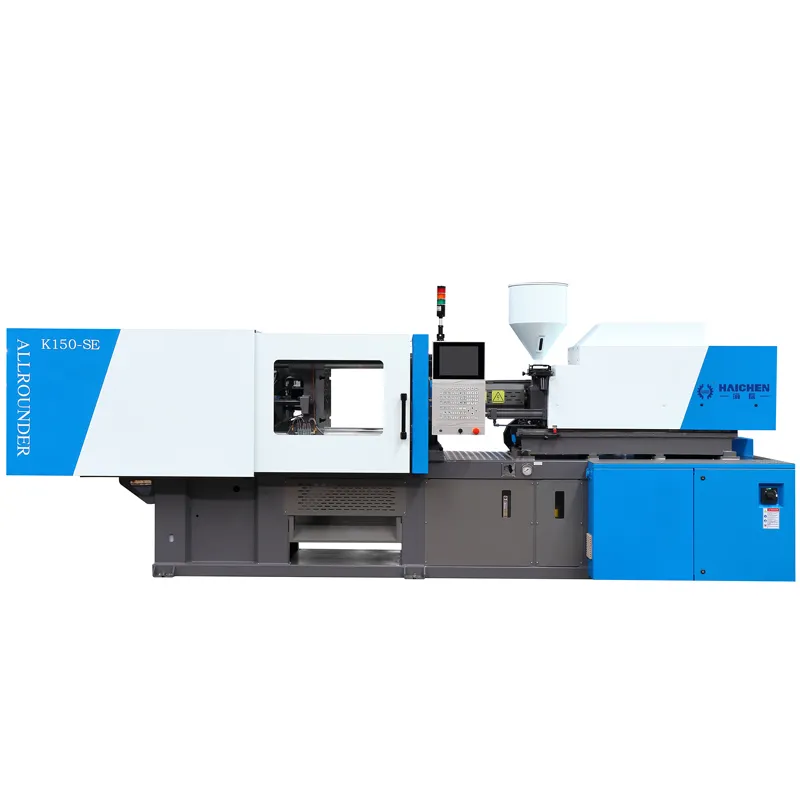
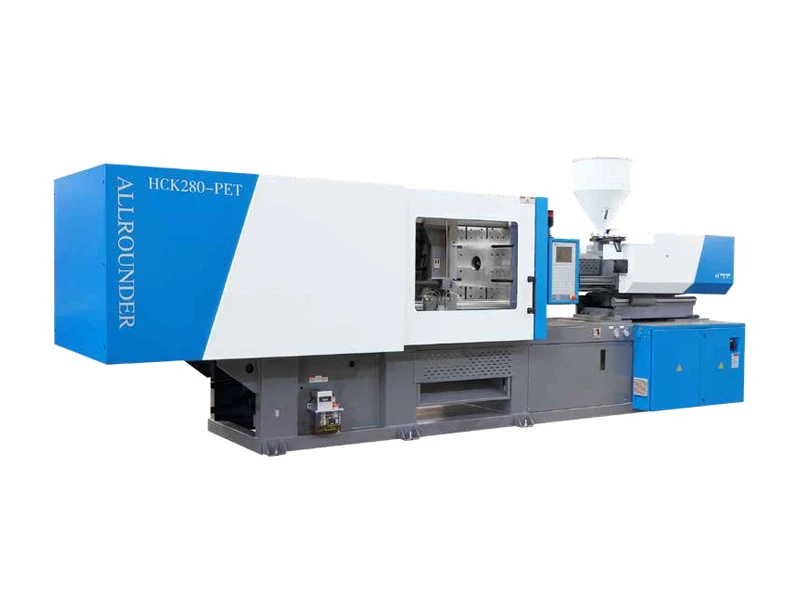
A plastic chair injection molding machine is the core equipment that turns plastic pellets into chairs, stools, and seating furniture for homes, gardens, offices, and public spaces. Choosing the right machine for chair production depends on three factors: material (PP, ABS, or PC), design (monobloc, armchair, stackable, or decorative styles like Napoleon, Phoenix, Tiffany, and Chanel), and size (projected area and part weight).
Standard plastic chairs typically require clamping force in the 600–1,000 ton range. Lightweight stackable PP chairs need 300–500 tons; standard dining chairs need 500–800 tons; heavy-duty outdoor chairs need 800–1,200 tons. For chairs under 2,500g, a 650-ton machine is typically recommended; for heavier chairs, 780 tons or more may be required.
This guide covers material-based injection unit design, chair design-based clamping unit configuration, tonnage selection for different chair types, and real production cases for Napoleon, Phoenix, Tiffany, and Chanel chairs — with practical selection data to help you make an informed decision.
Haichen Machinery has been building plastic chair injection molding machines for over 20 years. Our HCK series machines are designed specifically for chair and furniture production, with clamping forces from 280 to 1,200 tons and servo energy saving as standard. We have supplied machines to customers across Asia, the Middle East, South America, and Africa.
What Is a Plastic Chair Injection Molding Machine?
- PP (Polypropylene) – The most common material for plastic chairs. Lightweight, impact‑resistant, cost‑effective, and easy to mold. Standard PP chairs typically need 530–800 tons depending on design.
- ABS – Offers better surface finish and rigidity than PP. Higher viscosity requires 10–20% higher injection pressure and higher torque screw. Typical tonnage: 650–900 tons.
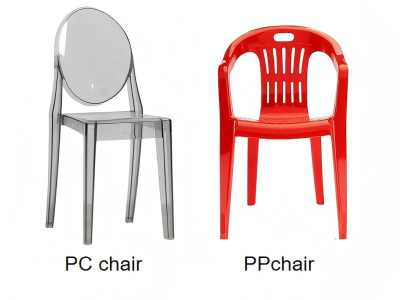
- PC (Polycarbonate) – Strong and transparent. PC has poor fluidity and requires a low‑shear screw with an L/D ratio of 22–24:1. A PC chair of the same size needs 1.5 to 1.8 times the tonnage of a PP chair, typically 900–1,200 tons.
A plastic chair making machine must handle large projected areas (the seat alone can measure 1,500–2,500 cm²), long flow paths, and thick walls (2.5–4.0 mm). The Haichen HCK series delivers all three with its high-rigidity clamping unit and optimized injection system.
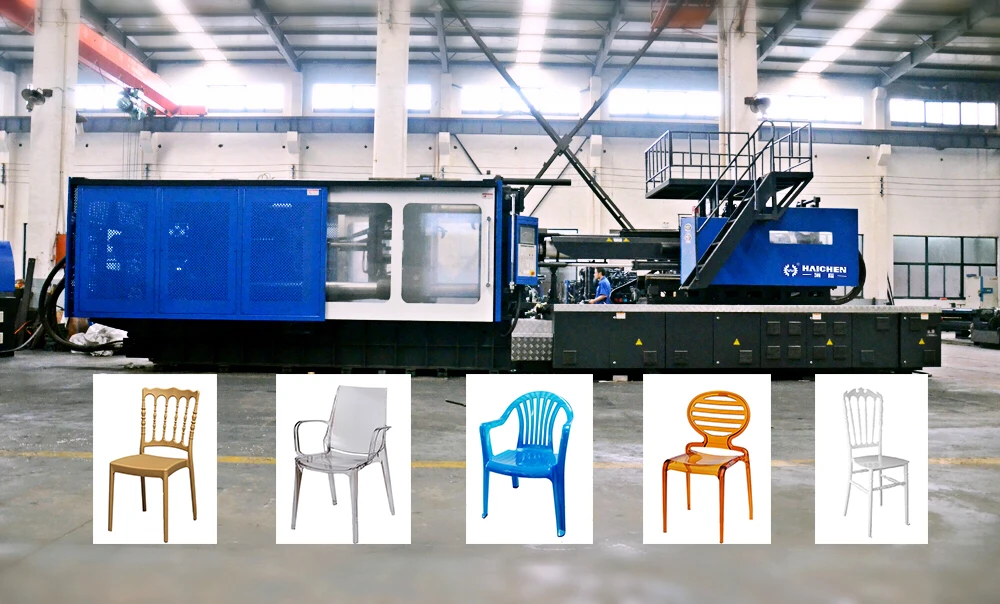
Material-Based Injection Unit Design – PP, ABS, and PC
Different plastics behave very differently during injection molding. The material you choose directly affects the machine tonnage, injection pressure, screw design, and temperature settings.
PP – High Flow, Low Pressure, Standard Screw
PP is the most common material for plastic chairs. It flows well, has a wide processing window, and requires moderate injection pressure — typically 300–500 bar. For PP chairs, we recommend a standard nitrided screw with a 65–75 mm diameter. A standard PP chair with armrests (80 cm) typically needs a 700–800 ton plastic chair injection molding machine.
PP chairs are lightweight, impact‑resistant, and cost‑effective. For chairs under 2,500g, a 650-ton machine is typically recommended; for heavier chairs, 780 tons or more may be required.
ABS – Higher Viscosity, Higher Torque Screw
ABS offers better surface finish and rigidity than PP. But it has higher viscosity, so it needs about 10–20% higher injection pressure. The screw also needs higher torque. For an ABS chair with armrests, we recommend a machine in the 750–900 ton range with a nitrided screw and higher torque motor.
ABS also requires careful temperature control — barrel temperatures typically range from 200–240°C, with mold temperatures at 40–80°C. Consistent temperature control is essential to prevent flow marks on visible surfaces.
PC – Poor Flow, Low‑Shear Screw Required
PC is strong and transparent, making it ideal for premium chairs. However, PC has poor fluidity — its melt flow index is much lower than PP. It needs high injection pressure, often 600–800 bar. PC also requires a low‑shear screw to prevent degradation.
A PC chair of the same size needs about 1.5 to 1.8 times the tonnage of a PP chair. For an 80 cm PC chair with armrests, we recommend a 1,100–1,200 ton machine with a PC‑dedicated low‑shear screw (L/D ratio 22–24:1, reduced compression ratio).
Haichen’s approach: We offer multiple screw options for different materials. For PP and ABS, our standard screws with nitrided surfaces work well. For PC, we provide low‑shear screws with a longer L/D ratio (22–24:1) and a reduced compression ratio. We also adjust the barrel heating zones for PC’s higher processing temperature (260–300°C).
Chair Design-Based Clamping Unit Configuration
The chair’s shape and structure determine how complex the mold is. This affects the opening stroke, tie‑bar spacing, and auxiliary features your plastic chair injection molding machine needs.
Deep‑Cavity and Monobloc Chairs – Longer Opening Stroke Required
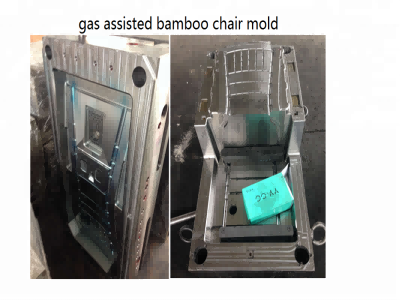
Monobloc chairs (one‑piece construction with backrest and legs) have large projected areas. A standard monobloc chair typically requires clamping force in the 600–1,000 ton range, depending on design and wall thickness.
If a chair has a large projected area (e.g., the seat part is about 2,000 cm²), the clamping force should be ≥600 tons. For deep‑cavity chairs, you need a longer opening stroke — at least 25–35% longer than the mold height.
Chairs with Armrests – Slider Cores and Higher Tonnage
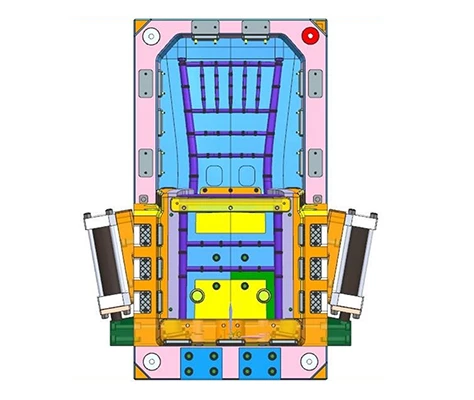
Chairs with armrests are wider, increasing the projected area. Armrests also often require slider cores in the mold for side actions. These sliders create lateral forces that stress the tie‑bars and platens. You need to add a 10–15% safety margin to the base tonnage when the chair has armrests.
For a PP chair with armrests (80 cm), the recommended tonnage increases from 530–700 tons to 700–900 tons. The HCK 700, HCK 800, or HCK 900 series machines are ideal for these applications.
Surface Textures and Decorative Patterns
Many chairs feature wood‑grain finishes, anti‑slip patterns, or embossed logos on the backrest. These details are etched into the mold cavity. While they do not significantly affect tonnage, they require precise temperature control and even filling. For PC chairs with deep textures, the HCK 1000 or HCK 1200 is often the best choice because it provides the high pressure needed to replicate fine details without causing stress marks.
Haichen’s approach: We check the mold drawing against the machine’s tie‑bar spacing, opening stroke, and mold height range before we recommend a model. For chairs with sliders, we ensure the plastic chair injection molding machine has enough hydraulic core‑pull interfaces. Our HCK series machines come with multiple independent core‑pull circuits as standard.
Tonnage Selection Guide for Different Chair Types
The table below shows recommended tonnage ranges for different chair types. Standard plastic chairs typically require clamping force in the 600–1,000 ton range. For chairs under 2,500g, a 650-ton machine is typically recommended; for heavier chairs, 780 tons or more may be required. The final selection depends on product size, weight, and design complexity.
| Chair Type | Typical Weight | Material | Recommended Tonnage | Haichen Model | Key Features |
|---|---|---|---|---|---|
| Children’s chair | 0.8–1.5 kg | PP | 250–500 tons | HCK 280–HCK 410 | Small projected area, thin walls |
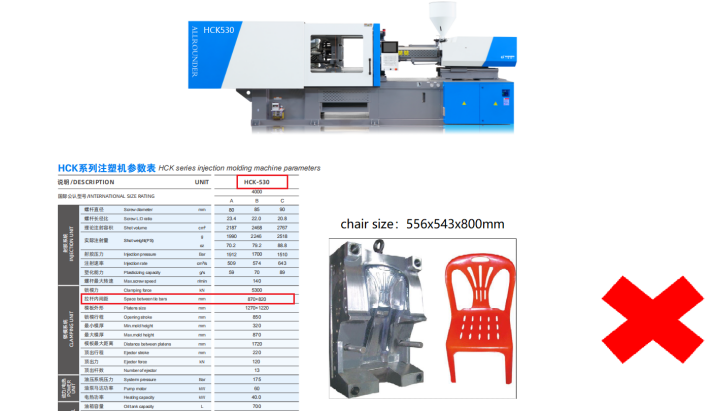
| Lightweight stackable chair | 1.2–1.8 kg | PP | 300–500 tons | HCK 530 | Simple geometry, fast cycles |
| Standard dining chair (no armrests) | 1.8–2.2 kg | PP | 500–700 tons | HCK 650 | Monobloc design, balanced performance |
| Standard dining chair (with armrests) | 2.0–2.8 kg | PP | 700–900 tons | HCK 700 / HCK 800 | Slider cores for armrests |
| Napoleon chair (ornate backrest) | 4.0–5.0 kg | PP/PC | 800–1,000 tons | HCK 900 / HCK 1000 | Complex backrest geometry, gas-assisted molding |
| Phoenix chair (thin-wall, high-speed) | 2.5–3.5 kg | PP/PC | 550–900 tons | HCK 650 / HCK 800 | High injection speed, thin-wall design |
| Tiffany / Chanel style chair | 2.0–3.5 kg | PC/ABS | 600–900 tons | HCK 700 / HCK 850 | Complex curves, high surface quality |
| Heavy‑duty outdoor chair | 2.8–4.5 kg | PP/ABS | 800–1,200 tons | HCK 900 / HCK 1200 | Thick walls, high load capacity |
| Large monobloc chair | 2.5–4.0 kg | PP/HDPE | 600–1,000 tons | HCK 650–HCK 1000 | Large projected area, long flow paths |
Real Production Cases – Napoleon, Phoenix, Tiffany, and Chanel Chairs
Case 1 – Napoleon Chair (PP with Glass Fiber, Gas-Assisted Molding)
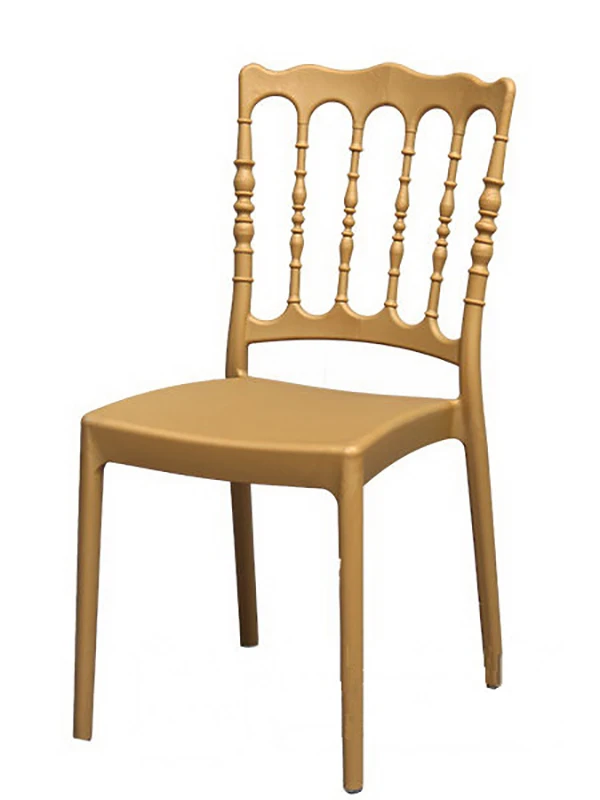
The Napoleon chair is an iconic design featuring an ornate backrest and elegant curves. It is typically made from polypropylene reinforced with glass fiber using gas-assisted injection molding technology. The chair weighs approximately 4–5 kg and is stackable up to 11 units.
Machine requirements:
- Tonnage: 800–1,000 tons (HCK 900 or HCK 1000)
- Key feature: Gas-assisted molding capability for hollow legs and complex backrest geometry
- Material: PP + glass fiber (higher viscosity requires higher injection pressure)
- Screw: Standard nitrided screw (75–80 mm diameter) with reinforced design for glass fiber
- Opening stroke: Longer than standard to clear the ornate backrest
Haichen recommendation: HCK 900 or HCK 1000 with gas‑assist interface and reinforced screw for glass‑filled PP. The gas‑assist system reduces clamping force requirements by 30–50% and prevents sink marks in thick sections.
Case 2 – Phoenix Chair (Thin-Wall, High-Speed Injection)
The Phoenix chair is known for its flowing curves and lightweight design. It is typically made from polycarbonate (PC) with a metal frame or full PC injection. The chair features a sleek, modern appearance and is often used in hospitality and event settings. PC resin phoenix chairs present a significant challenge for the injection molding process, requiring precise temperature control and high injection speed.
Machine requirements:
- Tonnage: 550–900 tons (HCK 650 or HCK 800)
- Key feature: High injection speed (≥150 mm/s) for thin-wall sections
- Material: PC (requires low‑shear screw, L/D 22–24:1)
- Temperature control: Multi‑zone PID with ±1°C accuracy, barrel 260–300°C
- Automation: Robot removal recommended to prevent damage to thin sections
Haichen recommendation: HCK 650 or HCK 800 with PC‑dedicated low‑shear screw, multi‑zone PID temperature control, and high‑speed injection capability. The PC phoenix chair requires precise process control to achieve the desired surface finish.
Case 3 – Tiffany Chair (Monoblock, Gas-Assisted Injection)
The Tiffany chair features a classic silhouette with a matte finish. It is built from monoblock polypropylene using gas‑assisted injection technology. The chair is stackable up to 10–11 pieces. Some versions use polycarbonate for premium transparent designs.
Machine requirements:
- Tonnage: 600–900 tons (HCK 700 or HCK 850)
- Key feature: Gas‑assisted molding for uniform wall thickness and smooth surfaces
- Material: PP or PC (material-dependent screw selection)
- Surface quality: High‑gloss finish requires precise temperature control
Haichen recommendation: HCK 700 or HCK 850 with gas‑assist interface. For PC versions, use the PC‑dedicated low‑shear screw. For PP versions, use the standard nitrided screw. The gas‑assist system ensures uniform wall thickness and prevents sink marks.
Case 4 – Chanel Style Chair (Clear PC, High Surface Quality)
The Chanel style chair is a premium design featuring elegant curves and a luxurious appearance. It is typically made from high‑quality transparent polycarbonate (PC) or acrylic resin using advanced injection molding technology. The chair weighs approximately 4.7 kg and is lightweight and stackable.
Machine requirements:
- Tonnage: 600–900 tons (HCK 700 or HCK 850)
- Key feature: High surface quality requires precise temperature control and consistent injection pressure
- Material: PC (low‑shear screw, L/D 22–24:1)
- Temperature control: Multi‑zone PID with ±1°C accuracy, barrel 260–300°C
- Automation: Robot removal with gentle gripping to prevent scratches
Haichen recommendation: HCK 700 or HCK 850 with PC‑dedicated low‑shear screw, high‑precision temperature control, and gentle robot handling. The transparent PC material requires precise temperature control to achieve the desired clarity and surface finish.
Haichen HCK Series for Chair Production
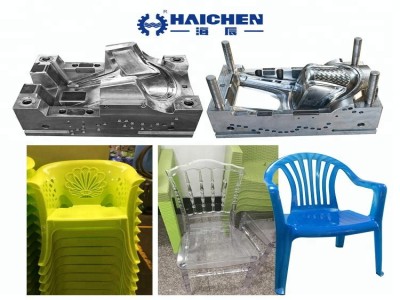
Haichen’s HCK series plastic chair injection molding machines are designed specifically for high‑volume furniture production. Our machines are built for 24/7 operation with minimal maintenance.
Recommended HCK Models for Chair Production
| HCK Model | Clamping Force | Recommended Chair Types | Typical Cavities | Key Features |
|---|---|---|---|---|
| HCK 280 | 280 tons | Children’s chairs, small stools | 1–2 cavities | Compact, energy efficient |
| HCK 410 | 410 tons | Lightweight stackable chairs | 1–2 cavities | Balanced performance |
| HCK 530 | 530 tons | Standard dining chairs | 1 cavity | High stability, good shot capacity |
| HCK 650 | 650 tons | Phoenix chairs, thin-wall designs | 1 cavity | High injection speed, heavy-duty clamping |
| HCK 700 | 700 tons | Dining chairs with armrests, Tiffany chairs | 1 cavity | Slider cores, gas‑assist ready |
| HCK 800 | 800 tons | Heavy‑duty chairs, large monobloc designs | 1 cavity | High clamping force, large platen |
| HCK 900 | 900 tons | Napoleon chairs, PC chairs | 1 cavity | Gas‑assist ready, low‑shear screw option |
| HCK 1000 | 1,000 tons | Large monobloc chairs, heavy PC chairs | 1 cavity | Maximum clamping for large parts |
| HCK 1200 | 1,200 tons | Extra‑large chairs, thick‑wall designs | 1 cavity | Ultra‑heavy‑duty, maximum rigidity |
All HCK series plastic chair injection molding machines come with:
- Servo energy saving – reduces electricity costs by 30–50%
- CE12 robot interface – supports automation integration
- Multi-zone PID temperature control – ±1°C accuracy
- Multi-stage injection and holding pressure control – for consistent part quality
- High-precision electronic ruler – for consistent shot weight
- Multi-language control system – supports 21 languages
- Hydraulic core-pull interfaces – standard for complex molds
- Gas‑assist ready – for hollow sections and thick parts
Haichen’s E series and HCK series machines are suitable for PC chair injection molding, PP raw material injection molding, and a wide range of furniture applications.
Frequently Asked Questions
What is the minimum tonnage for producing a plastic chair?
For a small children’s chair (under 40 cm, PP, no armrests), 250–500 tons may be enough. But for a standard adult chair (80 cm, PP, no armrests), you need at least 530 tons. For PC chairs or chairs with armrests, you need 700–1,200 tons. The optimal tonnage depends on the chair’s projected area, weight, and material.
Why does a PC chair need a higher tonnage machine?
PC has poor flow and requires high injection pressure. That high pressure creates high cavity pressure, which tries to push the mold open. PC typically needs 1.5 to 1.8 times the clamping force of PP for the same part. For standard PC chairs, clamping force typically falls in the 600–1,000 ton range, with some heavy designs requiring up to 1,200 tons.
What is gas‑assisted injection molding and why is it used for chairs?
Gas‑assisted injection molding injects nitrogen gas into the melt to create hollow sections. This reduces material usage, lowers clamping force requirements by 30–50%, and prevents sink marks in thick sections. It is commonly used for Napoleon, Tiffany, and other premium chair designs to achieve lightweight, durable products.
Can one plastic chair injection molding machine produce different chair designs?
Yes, by changing molds. However, different chair designs may require different configurations. For example, a Napoleon chair requires gas‑assist capability, while a Phoenix chair requires high injection speed. We recommend dedicating machines to specific chair types for optimal efficiency. Frequent changeovers waste time and affect consistency.
What special features does a chair with armrests need?
It needs hydraulic core‑pull interfaces to control the sliders in the mold. Haichen HCK series plastic chair injection molding machines come with multiple independent core‑pull circuits as standard. You also need to add a 10–15% safety margin to the base tonnage when the chair has armrests.
How do I know if my mold will fit the machine?
Check three dimensions: tie‑bar spacing, mold thickness range, and opening stroke. The mold must fit within all three. For deep‑cavity chairs like monobloc designs, ensure the opening stroke is at least 25–35% longer than the mold height. We always check these parameters for you when you provide your mold drawing.
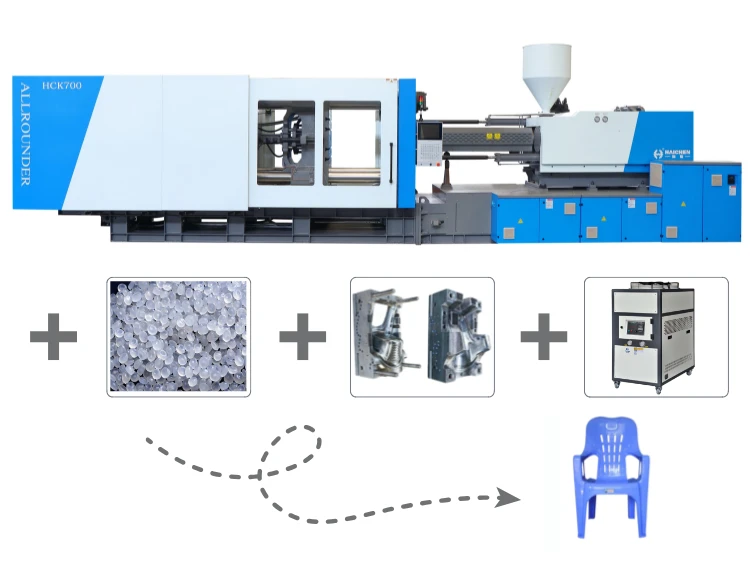
Haichen Machinery – your plastic chair injection molding machine partner. From HCK 280 to HCK 1200, from children’s chairs to Napoleon chairs, we help you get the right machine for your chair production.
Author: Yang, Senior Engineer, Haichen Machinery