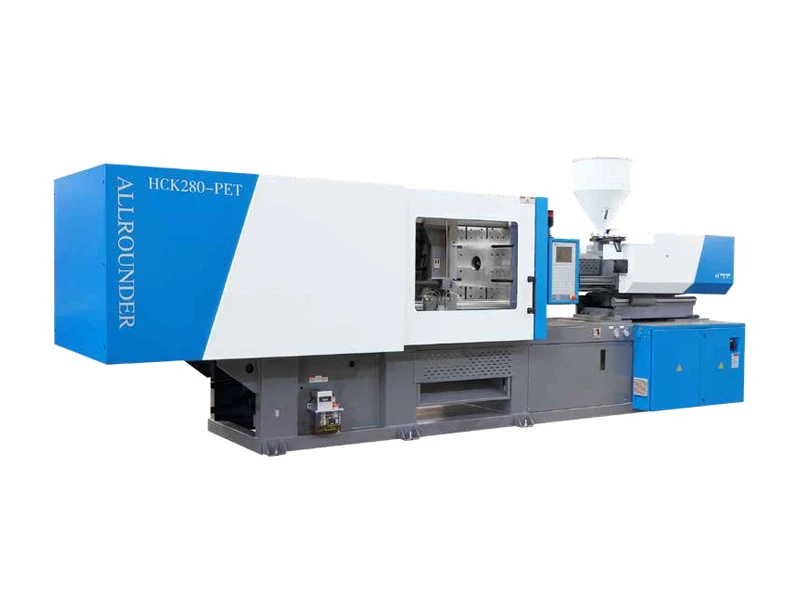
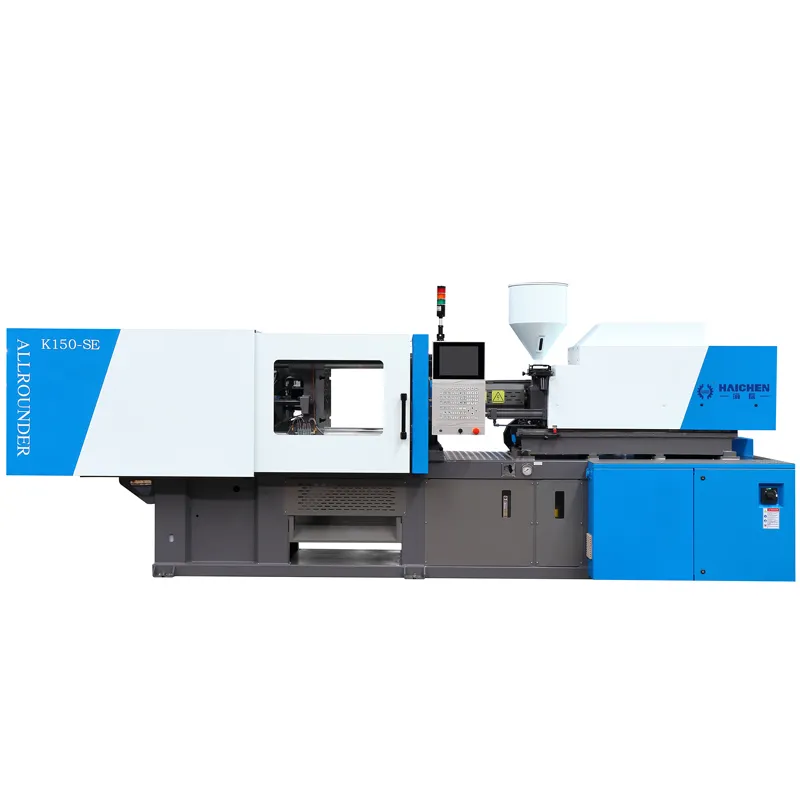
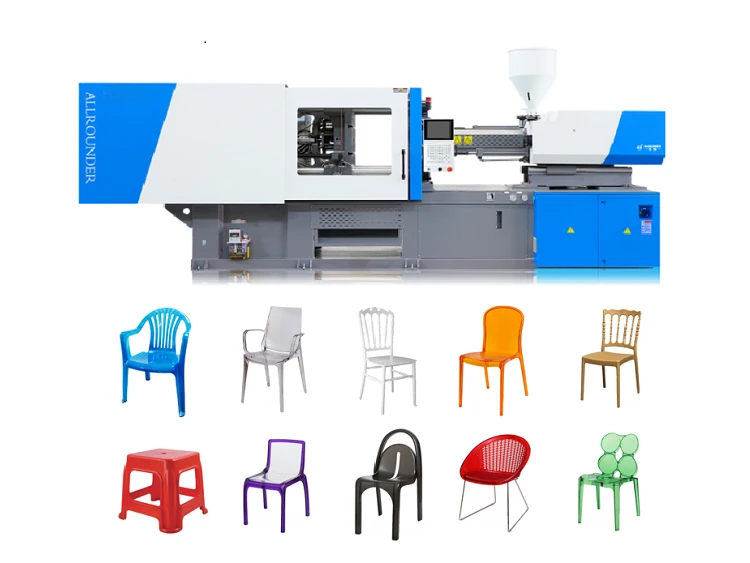
When choosing a plastic chair injection molding machine for your production, the most important thing is to select one that suits the specific product design and the raw materials used.Choosing an injection molding machine is a major investment decision that impacts product quality, operating costs, and production efficiency. A suitable machine balances technical performance, cost control, and production scale while ensuring consistent product quality throughout its lifespan.
Machine selection for plastic chairs depends on three main factors. First, the material – PP flows easily and needs less clamping force, while PC has poor fluidity and requires much higher injection pressure and tonnage. Second, the size – a full chair with legs has a larger projected area than just a seat pan, directly increasing the required clamping force. Third, the design – chairs with armrests are wider and often need slider mechanisms, adding complexity and tonnage.
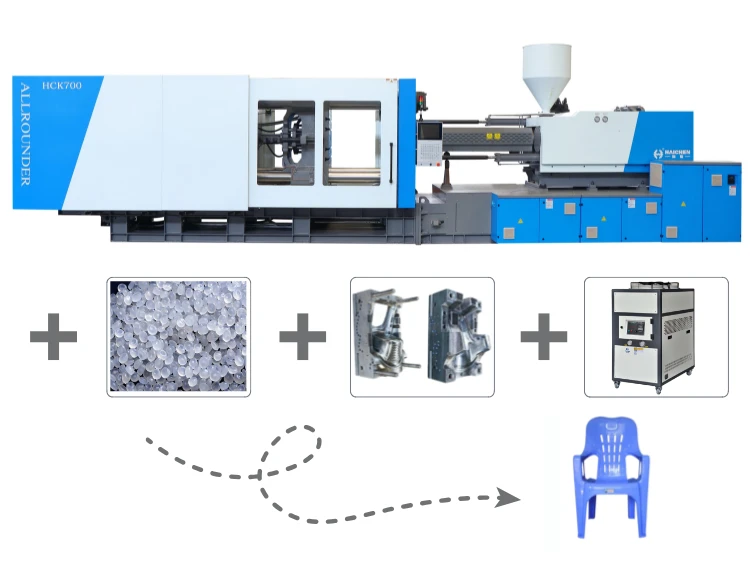
Our HCK series covers the entire range from 530 to 1200 tons. The table below gives you a clear starting point for matching your chair to the right machine.
| Material | Chair Type | Typical Size | Recommended HCK Model | Clamping Force (tons) | Key Technical Notes |
|---|---|---|---|---|---|
| PP | Seat pan only | 80cm | HCK530 | 530 | Thin‑wall, fast cycles |
| PP | Full chair without armrests | 80cm | HCK600 | 600 | Standard monobloc |
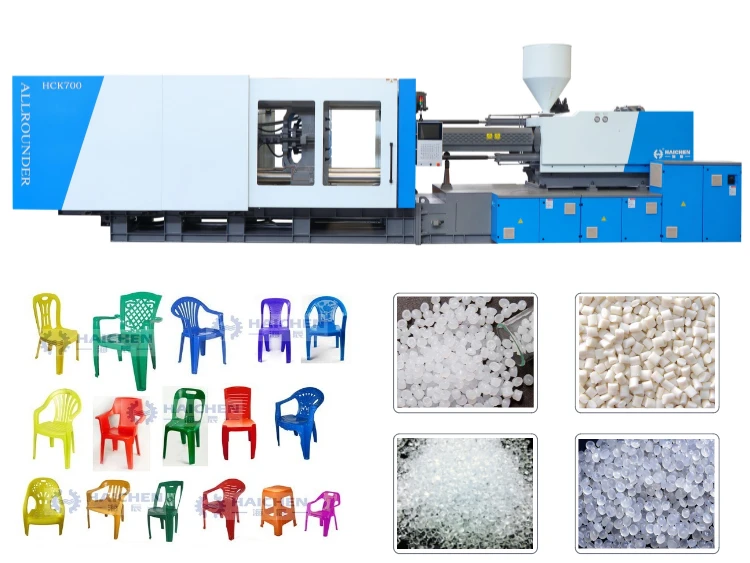
| PP | Full chair with armrests | 80cm | HCK700 | 700 | Slider cores for side holes |
| ABS | Full chair without armrests | 80cm | HCK700 | 700 | Higher viscosity, needs more pressure |
| ABS | Full chair with armrests | 80cm | HCK800 | 800 | Larger projected area + side forces |
| PC | Full chair without armrests | 80cm | HCK800 | 800 | PC flows poorly, needs high tonnage |
| PC | Full chair with armrests (transparent) | 80cm | HCK1200 | 1200 | Maximum stability for quality |
| PC / ABS | Oversized or thick‑wall designs | >80cm or heavy | HCK1000 / HCK1200 | 1000‑1200 | For heavy furniture or complex molds |
What Makes Outdoor Chair Production Different from Indoor Chairs?
Outdoor chairs and indoor chairs look similar, but the production requirements are completely different. Indoor chairs mainly focus on appearance and basic weight support. Outdoor chairs have to survive sun, rain, temperature changes, and heavy adult use — a 150 kg person sitting down hard, the chair can’t crack or deform. Standard outdoor chair safety loads typically range from125 to 150 kg, which places clear demands on the structural strength of the injection-molded parts.
Material selectionis another key difference. Outdoor chairs cannot use ordinary plastics. Standard plastics degrade under UV exposure — they fade, powder, and become brittle. Outdoor chair materials must includeUV stabilizers and titanium dioxideto resist sun damage. HDPE offers good rigidity and weather resistance. PP flows well for complex shapes. The choice depends on your target market’s expected service life and budget.
Structural designalso differs significantly. Outdoor chairs have much larger projected areas than indoor chairs — the seat alone can measure2000 cm². This means they need higher clamping force: a standard monobloc outdoor chair typically needs600–1000 tons, and large thick-wall outdoor chairs can require800–1300 tons. Outdoor chairs also need longer flow paths, uniform wall thickness, and balanced cooling systems to prevent warpage — because dimensional stability is what maintains load-bearing capacity.
Simply put, outdoor chairs are not just “chairs placed outside.” They are engineered products that must maintain structural integrity in harsh environments for years. That’s why the injection molding machine requirements are significantly higher.
| Factor | Indoor Chair | Outdoor Chair |
|---|---|---|
| Load capacity | 80–100 kg | 125–150+ kg |
| UV resistance | Not required | UV stabilizers + titanium dioxide |
| Projected area | 800–1200 cm² | 1500–2500+ cm² |
| Clamping force needed | 300–600 tons | 600–1000+ tons |
| Typical materials | PP, ABS | HDPE, UV-stabilized PP |
| Wall thickness | 2.5–3.5 mm | 3.0–5.0 mm |
- Material Matters – How Plastic Type Affects Machine Choice
- Size Counts – Full Chair vs. Seat Pan, and How Thickness Changes Things
- Design Details – Armrests, Textures, and Hollow Sections
Material Matters – How Plastic Type Affects Machine Choice
- PP – The Easy‑Flowing Workhorse
- ABS – Stiffer, but Demands More Pressure
- PC – Beautiful, But Challenging
PP – The Easy‑Flowing Workhorse
PP is the most common material for outdoor and household chairs. Its melt flow index is high, so it fills cavities easily. This means you can run it at lower injection pressures – typically 300‑500 bar. For a standard 80cm PP chair without armrests, our HCK600 provides more than enough clamping force. If you add armrests, the projected area grows, and we step up to HCK700. PP also allows thinner wall designs, which reduces shot weight and cycle time.
ABS – Stiffer, but Demands More Pressure
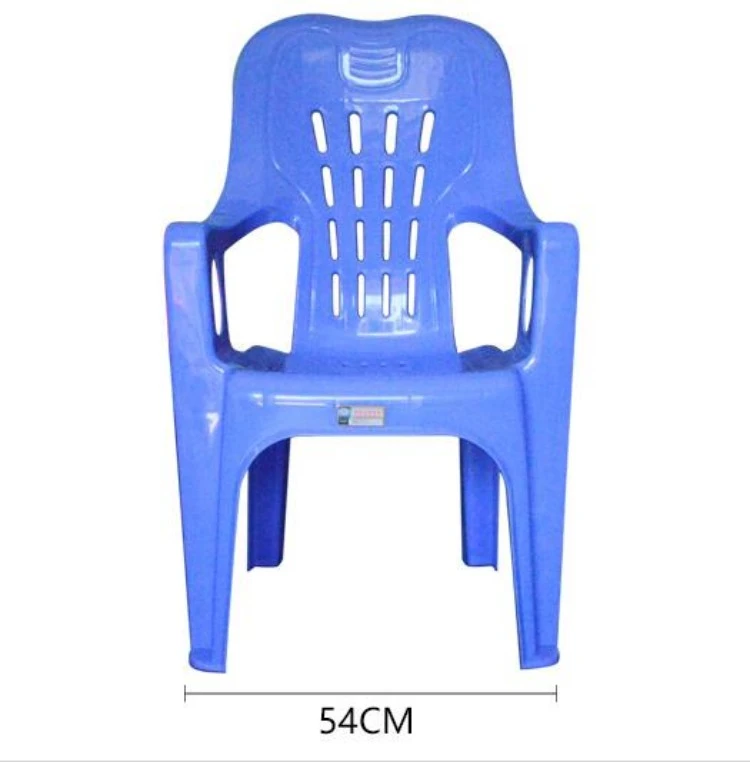
ABS gives chairs better rigidity and a glossy surface. It is often used for office and school furniture. However, ABS has higher viscosity than PP. It needs about 10‑20% more injection pressure. This raises the cavity pressure, so you need a higher clamping force. For an 80cm ABS chair with armrests, we recommend HCK800 – 800 tons gives you a comfortable safety margin. One of our customers switched from PP to ABS for a premium school chair line. Their old 600‑ton machine could not fill the mold completely. We supplied an HCK800, and the scrap rate dropped from 15% to below 2%.
PC – Beautiful, But Challenging
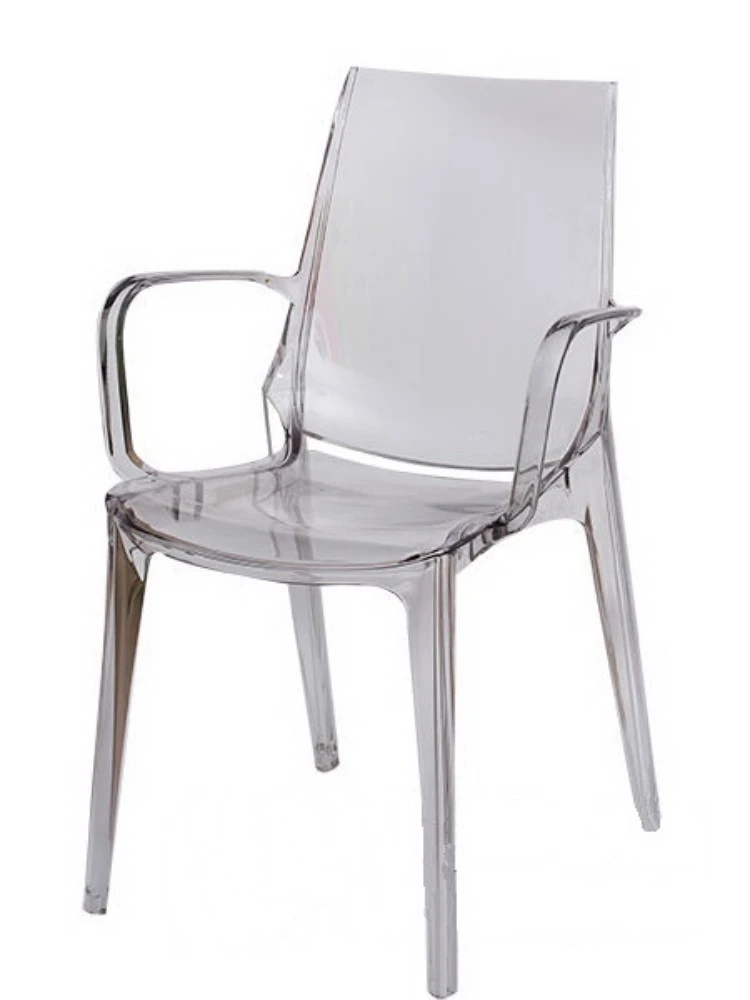
PC is the most demanding material. It offers transparency and high impact strength, but its melt flow index is extremely low – often 10 times lower than PP. This means you need injection pressures up to 800 bar or more. For the same chair, PC requires roughly 1.5 to 1.8 times the tonnage of PP. An 80cm PC chair with armrests needs a HCK1200 – 1200 tons – to keep the mold tightly closed under high pressure. We had a customer who tried to run a transparent PC armchair on a 700‑ton machine. The result was flash on the edges and short shots in the backrest. After upgrading to HCK1200, the scrap rate fell from 40% to under 5%, and the surface texture came out perfectly clear.
Size Counts – Full Chair vs. Seat Pan, and How Thickness Changes Things
During the equipment conversion phase, manufacturers no longer test various options but instead filter through machines that meet their production goals and prepare for the final selection.Plastic chairs come in many shapes and sizes – adult seats around 80cm tall, some with armrests, some without, and some just as seat pans. They use different materials like PP, ABS, and PC. Each combination of material, size, and design demands a specific injection molding machine. You cannot use the same tonnage for a lightweight PP chair and a transparent PC chair with armrests.
- Projected Area Is the Key Number
- Wall Thickness and Shot Weight
- Real Case – From Seat Pan to Full Chair
Projected Area Is the Key Number
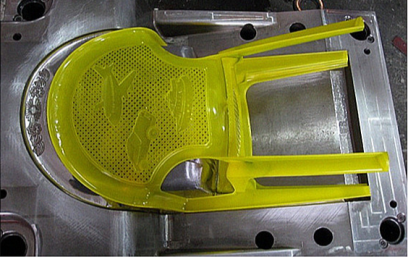
Clamping force is directly proportional to the projected area of the part (including runners) times the cavity pressure. A full chair with a backrest and legs has a much larger projected area than a seat pan alone. For a simple seat pan (around 50x50cm), a HCK530 works well. For a full 80cm chair, you need at least HCK600 for PP or HCK700 for ABS. The increase is not linear – as the chair gets taller or wider, the projected area grows quickly.
Wall Thickness and Shot Weight
Thicker walls mean longer cooling time and larger shot weight. A standard chair weighs 1500‑3000 grams. Our HCK machines have large screw diameters to handle such shot sizes. For example, the HCK700 can plasticize over 80g/s, enough for most chairs. However, if your design has extra‑thick sections (like reinforced legs or solid armrests), you might need a larger plasticizing unit or a longer cycle. In such cases, we often recommend stepping up to HCK800 plastic chair injection molding machine even for PP, to get a larger screw and faster recovery time.
Real Case – From Seat Pan to Full Chair
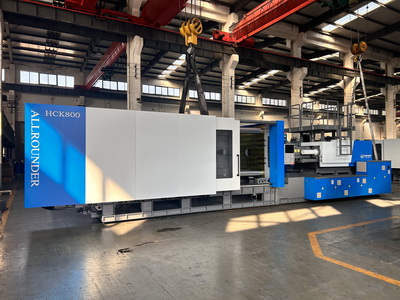
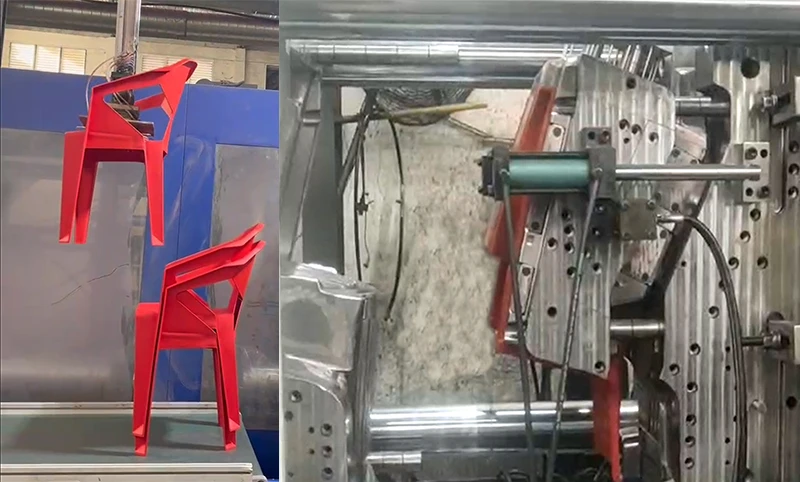
A customer started with a simple seat pan for garden furniture. We supplied an HCK530 plastic chair injection molding machine. Later, they expanded to full chairs with backrests. The 530‑ton machine could not handle the larger projected area – the mold flashed and parts warped. We upgraded them to an HCK700, which now runs both the seat pans (with a different mold) and the full chairs without any issues. The customer saved money by starting small and scaling up when their business grew.
Design Details – Armrests, Textures, and Hollow Sections
- Armrests Add Width and Side Forces
- Surface Textures and Decorative Patterns
- Gas‑Assisted Molding for Hollow Sections
- Real Case – PC Chair with Wood‑Grain Texture and Hollow Armrests
Armrests Add Width and Side Forces
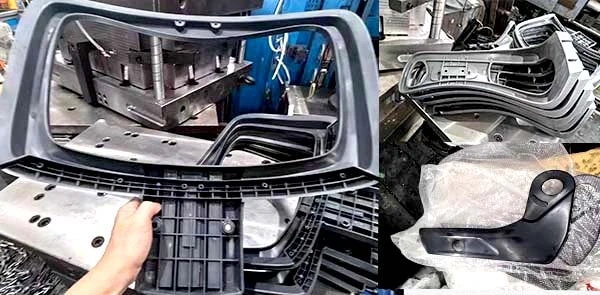
A chair with armrests is wider and has a larger projected area. But that is not the whole story. Armrests often have undercuts or side holes, which require slider cores in the mold. Sliders create side forces that push against the tie‑bars. This means you need extra clamping force to keep the mold rigid. We recommend adding 10‑15% to the base tonnage when the design includes armrests. For example, an 80cm ABS chair without armrests uses HCK700; with armrests, we move to HCK800.
Surface Textures and Decorative Patterns
Many chairs feature wood‑grain finishes, anti‑slip patterns, or brand logos embossed on the backrest. These details are etched into the mold cavity. While they do not significantly affect tonnage, they demand precise temperature control and even filling. If the injection pressure is too low, the texture will not form completely. For PC chairs with deep textures, the HCK1200 is often the best choice because it provides the high pressure needed to replicate fine details without causing stress marks.
Gas‑Assisted Molding for Hollow Sections
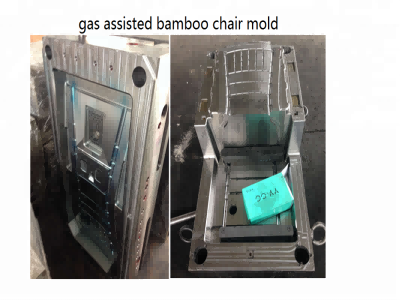
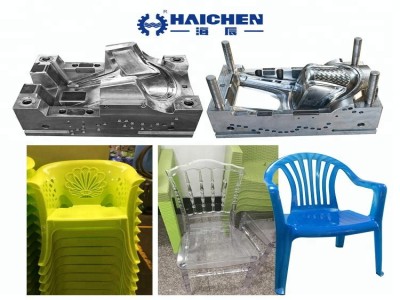
For premium designs – especially tubular armrests or thin‑but‑strong backrests – gas‑assisted plastic chair injection molding machine is an excellent technique. Gas is injected into the melt to create hollow channels. This reduces the amount of plastic, lowers the clamping force needed by 30‑50%, and speeds up cooling. We have successfully integrated gas‑assist systems with our HCK machines. For example, a PC armchair that normally needs 1200 tons might run on HCK800 with gas assistance, saving energy and machine cost. However, gas‑assist requires careful mold design and additional control hardware – we can guide you through the setup.
Real Case – PC Chair with Wood‑Grain Texture and Hollow Armrests
A high‑end furniture brand wanted to produce a transparent PC chair with a wood‑grain pattern on the backrest and hollow armrests. They initially tried a 700‑ton machine. The texture was incomplete, the armrests had sink marks, and the scrap rate was over 40%. We analyzed their mold and recommended the HCK1200 with a gas‑assist system for the armrests. The new setup achieved a cycle time of 65 seconds, a scrap rate below 5%, and the wood‑grain pattern came out perfectly. The customer recovered the extra investment within 18 months through reduced waste and higher output.
Common Questions – Let’s Discuss
Q1: Why does PC need so much more tonnage than PP?
PC has poor fluidity – it flows like honey compared to water. To push it into a large mold, you need high injection pressure, which creates high cavity pressure. That pressure tries to open the mold. If your clamping force is not high enough, the mold opens slightly, causing flash and short shots. PC typically requires 1.5 to 1.8 times the tonnage of PP for the same part.
Q2: Can I use a smaller machine with gas‑assisted molding?
Yes. Gas‑assist reduces the pressure needed to fill the mold by creating hollow sections. This can lower the required clamping force by 30‑50%. However, it adds complexity and cost. We recommend it for high‑volume production of premium chairs with hollow armrests or backrests.
Q3: What is the minimum machine for a full adult chair?
>>For PP, we recommend at least HCK600 for a basic design. Using ABS, HCK700. For PC, HCK900 or more. If the chair has armrests, add one step up – e.g., HCK700 for PP with armrests, HCK800 for ABS with armrests, HCK1200 for PC with armrests.
Q4: Do surface textures affect machine selection?
Not directly on tonnage, but they affect injection speed and temperature control. Fine textures need precise pressure to replicate. If you run PC with deep textures, we recommend going for a higher tonnage (e.g., HCK1000 instead of HCK900) to ensure full pressure without stress marks.
Q5: How do I know which tonnage is exactly right for my chair?
We need your part’s projected area (including runners) and the material’s required cavity pressure. We can calculate the tonnage precisely using a formula. Send us your 3D drawing or mold specifications – we will give you a free, detailed machine recommendation.
We welcome your comments below. Share your experience with plastic chair production, or ask us about your specific design. We are here to help you find the right HCK machine.
Haichen Machinery – Plastic chair injection molding solutions from 530 to 1200 tons. Tailored for PP, ABS, and PC.
Author: Yang, Senior Engineer, Haichen Machinery