
Plastic Crate Production Line – A Complete Manufacturing Solution
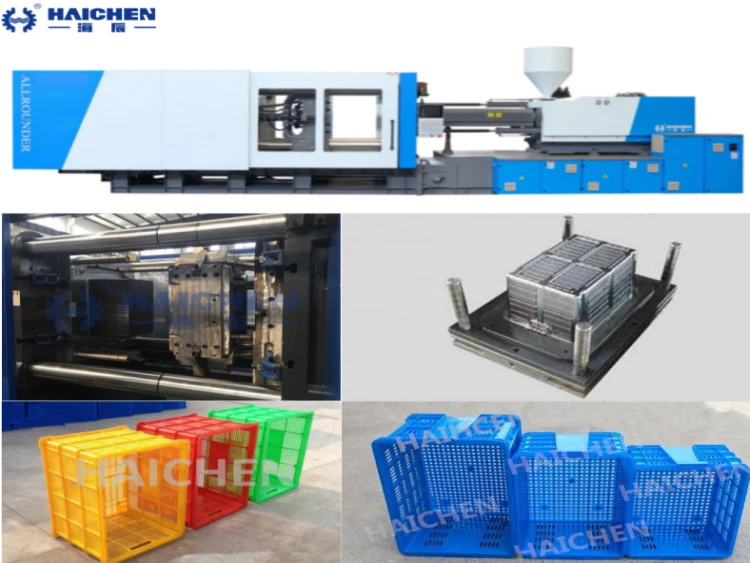
This guide covers the different types of crates and their production requirements, a real production case from Kyrgyzstan, and the core advantages of the HCK servo series. We also walk you through machine selection criteria to help you choose the right crate injection molding machine for your specific needs.
Types of Plastic Crates and Their Production Needs
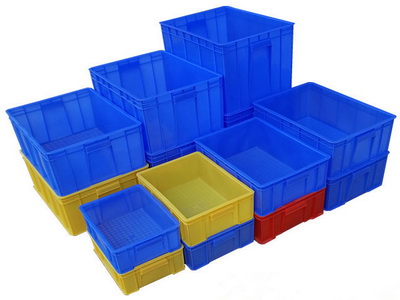
Fruit Crates – Light, Breathable, and High Stacking Stability
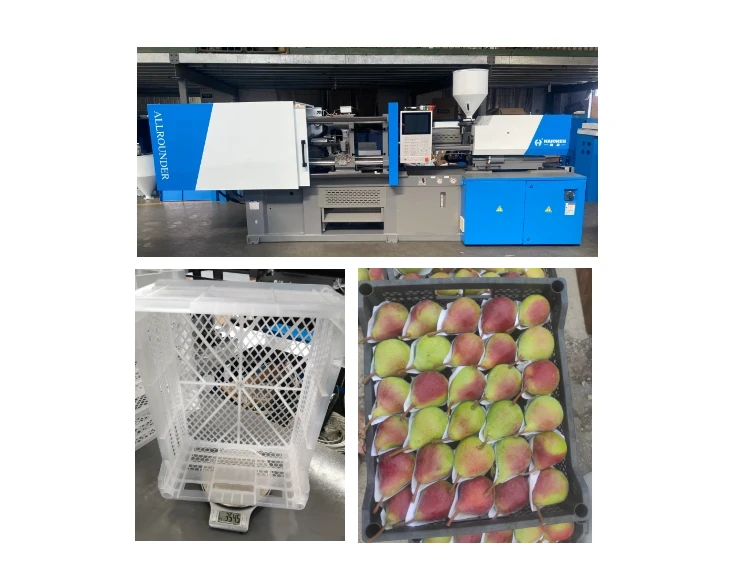
Fruit crates protect delicate produce during transport. Early apricots and peaches measure 10–20 cm across with soft skins that bruise easily. These crates must meet three requirements: good ventilation, light weight, and high stacking stability. Our 400 × 450 × 120 mm crate weighs only 325 g, holds over 10 kg, and stacks up to ten layers high. The honeycomb side pattern provides airflow, and embedded legs at the four corners transfer weight to the lower crate’s rim, not onto the fruit. A plastic crate production line for fruit typically uses multi-cavity molds and fast-cycle machines to handle seasonal harvest demands.
Fresh Produce Trays – Fast Cycle, Thin-Wall, Multi-Cavity Molds
Fresh produce trays require thin-wall design and huge output. A single order may need hundreds of thousands of pieces within a short production window. Multi-cavity molds and large-tonnage thin-wall specific machines are essential. The machine’s response speed, mold stability, and automation capabilities must be significantly higher than for standard fruit crates. A well-configured plastic crate making machine for produce trays can cut cycle times while maintaining consistent part quality.
Returnable Beverage Crates – Complex Inner Structures, Hydraulic Core Pull
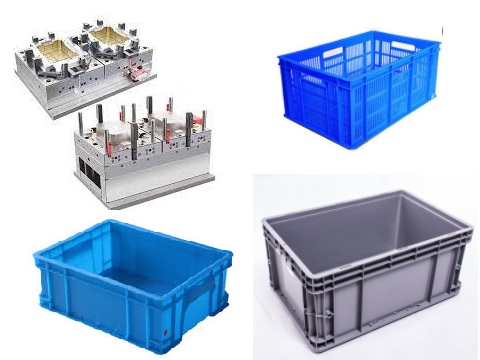
Beer and milk crates face a different challenge: intricate internal features like divider grooves, reinforcing ribs, and bottle positioning slots. These create multiple undercuts that require sliders or lifters for side actions. You need a crate injection molding machine with hydraulic core pull functions. Our HCK series PLC control system has preset multiple independent core-pull interfaces that can control slider movement in sequence and sync with robot actions.
Sealed Seafood Crates – Thick Walls, High Clamping Force
Seafood crates demand water-tight sealing. The sealing edge must form a precise groove for a rubber gasket, requiring full filling without flash or sink marks. Wall thickness often reaches 3–3.5 mm, compared to 1.5–2.5 mm for regular fruit crates. Higher holding pressure and longer holding time are essential. For such products, some customers choose HCK530 machines with an accumulator – it releases extra force instantly when needed, ensuring thick sections fill completely. A robust plastic crate production line for seafood must handle these demanding conditions.
The 2018 Kyrgyzstan Fruit Crate Production Case – A Real Walkthrough
Project Background – An Orchard and a Single-Use Crate Need
In 2018, a customer from Kyrgyzstan found Haichen through our official website, then flew to Ningbo to tour our factory and showroom. He ran an orchard and needed to transport ripe apricots and peaches to market. The fruits were large and soft, so he needed a custom single-use shipping crate that protected the produce, controlled cost, and arrived in time for that season’s harvest.
Product Design and Mold Development
We spent considerable time analyzing the fruit’s features. Ripe apricots and peaches measure 10–20 cm with thin skin and lots of juice. They fear squeezing and pressure from the upper crate. After several rounds of 3D modeling, we finalized a 400 × 450 × 120 mm crate with a target weight of 325 g. It needed stacking stability and 10 kg load capacity per crate. Honeycomb vents on all sides and embedded legs at the four corners ensure that when stacked up to ten layers, the legs transfer weight to the lower crate’s frame, not to the fruit inside.
For ejection, we offered three proven options: manual removal (good for beginners or tight budgets), air valve ejection (cost-effective and greatly improves automation), and stripper plate ejection (for larger or heavier crates). The customer chose the air valve solution based on his investment and application.
Machine Selection – HCK310 Delivers 3 Cycles Per Minute
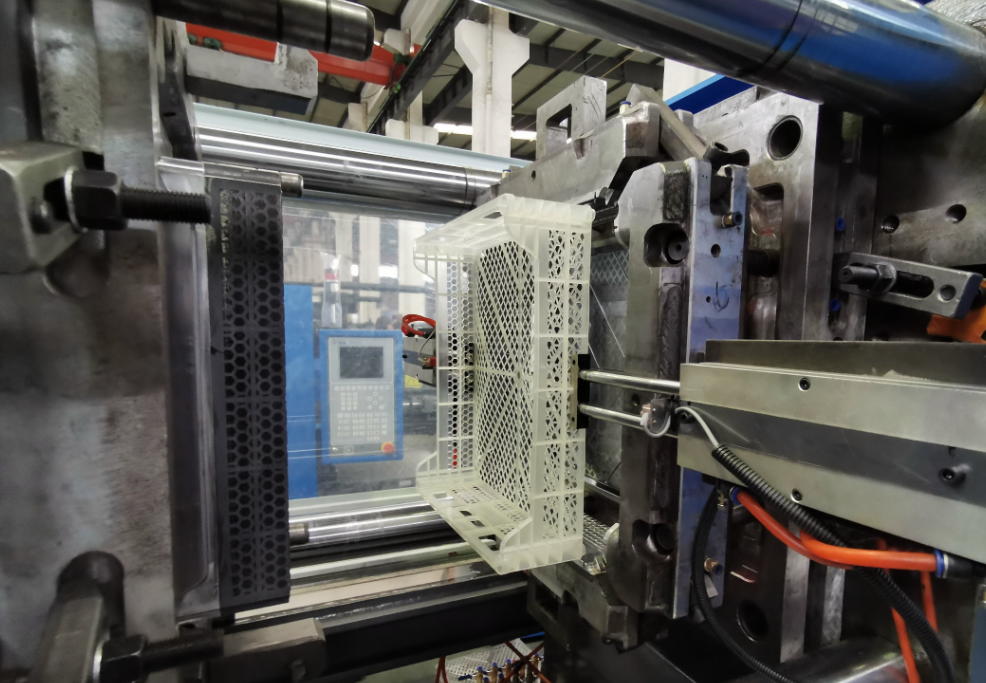
The final mold size was 550 × 450 × 280 mm. Based on those dimensions and the part weight, we selected the HCK310 mid-size machine. Its clamping force, tie-bar spacing, and opening stroke easily handle this mold. Fast injection and stable holding pressure are critical for thin-wall fruit crates. We achieved about 3 cycles per minute – a production rate that satisfied the customer’s sales needs while keeping energy use reasonable. The plastic crate production line ran smoothly from part pickup to sprue cutting to stacking, thanks to the HCK310’s dual-platform design and quick injection response.
Core Advantages and Expandable Features of HCK Servo Series
Servo Energy Saving – 30%–60% Less Power vs. Traditional Machines
Rising electricity costs make many crate producers pay close attention to energy use per part. HCK series machines stand out because of their servo-driven hydraulics. The servo system uses closed-loop control. The motor stops completely during phases where the machine does nothing (like cooling). Old-style constant-pump hydraulic machines keep running idle, wasting power. Based on real customer feedback, HCK machines typically save 30% to 60% electricity compared to same-tonnage older models. For a plastic crate production line running 24/7 during peak season, that saving turns directly into profit.
Tie-Bar + Guide Rail Dual Platform – Stability for Complex Molds
Fruit crate molds often have multi-cavity layouts and need high platen parallelism. Traditional clamping units can wobble at high speed, especially when the mold is complex and has many cores. That wobble can cause flash or dimensional problems. HCK series uses a dual-platform design (tie-bars plus linear guide rails). The moving platen runs with good rigidity and almost no side play. Control precision reaches micron level. Even with high-end molds like those for beer crates with many sliders, you won’t see uneven force that damages the tool or produces bad parts.
Smart Control and CE12 Robot Open Interface
When crate production hits peak season, relying on manual part removal and packing becomes very hard, and night-shift labor costs add up. Large crate production bases now widely adopt automation. HCK series comes with a CE12 open interface – a standardized industrial signal protocol. We factory-configure all process points and wiring logic. If a robot supports the CE12 protocol, it can sync timing accurately with the machine. In recent years, many customers have used this interface to connect robots, conveyors, stackers, and sprue cutters – achieving fully unattended operation from raw material to finished pallet. This makes the plastic crate production line future-ready for lights-out manufacturing.
Frequently Asked Questions
Is the single-use fruit crate market changing? Will environmental policies affect it?
The market still grows steadily. Looking toward 2030, regulations will push crates toward recyclable and easy-separation designs. As a machine builder, we keep upgrading HCK series to handle recycled or modified materials.
How do we reduce warpage on thin-wall fruit crates?
The key lies in holding pressure curve optimization and proper mold temperature. HCK series includes servo pressure closed-loop control, which allows multi-stage holding pressure with accurate output. This greatly reduces internal stress.
For beer crates with many sliders, what special machine features do we need?
The most important needs are hydraulic core-pull interfaces and sequence valve control. HCK series standard-offers modular multi-group core-pull circuits that sync with machine timing. You can set each core-pull action independently on the touch screen – very convenient for mold engineers.
Can HCK machines pair with automatic part removal and stacking?
Absolutely. The CE12 open protocol control system exchanges signals with most robot brands, enabling full automation. From part pick-up, sprue cutting, conveying, to stacking – the whole workflow works seamlessly.
What is the typical clamping force range for a plastic crate production line?
It depends on crate size and cavity count. Small fruit crates with multi-cavity molds typically need 150–360 tons. Large beverage or seafood crates may require 410–800 tons. Haichen covers the full range with HCK series machines from 110 to 800+ tons.
We welcome your questions below. If you have any questions about fruit crate mold design or HCK machine configuration, feel free to contact us. We can give you a detailed recommendation based on your actual production needs.
Haichen Machinery – Based in Ningbo, focused on efficient plastic crate production line solutions for over 20 years.
Author: Yang, Senior Engineer, Haichen Machinery


